

Do you need a filament dryer in Singapore's humid air?
A filament dryer takes water out of damp 3D printer filament. Which spools need one in Singapore's humid air, the settings, and how to store spools dry.
How damp is the air in Singapore right now?
The latest reading from the weather stations around the island, beside what a filament maker wants a spool kept at.
Reading the stations…
What are you drying?
Live data: Meteorological Service Singapore stations, through data.gov.sg. Drying settings: one filament maker's table, for its own spools; other makers differ.
A filament dryer warms a spool gently so the water it soaked up from the air leaves again. In Singapore, where the air averages around 82% humidity, TPU and nylon should be dried before they print, and PETG and PLA once a spool has sat open. If you print only a little PLA, a sealed box with desiccant may be all you need.
Which filaments need drying
| Filament | How badly it suffers | Dry before use? | One maker’s drying setting |
|---|---|---|---|
| PLA | Least: its properties change little | Recommended once a spool has sat open | 45°C for 6 hours |
| PETG | Listed as hygroscopic by one maker | Recommended once a spool has sat open | 55°C for 6 hours |
| TPU | Often needs drying | Required by one maker’s table | 60°C for 4 to 6 hours |
| Nylon (a carbon-fibre blend shown) | The worst: affected quite significantly | Required by one maker’s table. Another says dry it, or keep it in a dry box | 90°C for 6 hours |
The settings are Prusa’s, for its own filament. Another maker’s table gives other times, so read your spool’s label. Never go above the temperature given for the filament, because it will soften and stick together.
Why Singapore’s air wets filament
Most filament is hygroscopic: it readily attracts water molecules from the air around it. Singapore’s Meteorological Service says humidity is above 90% just before sunrise and falls to around 60% on afternoons without rain. The mean for the year is around 82%.
So a spool left on the shelf is a spool that is slowly drinking. The longer it sits open, and the more humid the room, the more it takes up.
Signs the spool is wet
A wet spool usually tells you while it prints. Look and listen for these:
- Popping or crackling at the nozzle.
- Bubbles in the plastic as it comes out.
- More stringing than the same spool gave you before.
- A rough surface, or small holes in the walls.
- Weak layers, and a part that is less strong than it should be.
The water vaporises in the hot nozzle, which swells the molten plastic and changes the flow. Dry the spool before you blame the slicer settings. Our guide to FDM print defects shows what stringing and rough walls look like, and the common printer problems page covers the rest.
A filament dryer: the easy way
A filament dryer is a heated box that warms the spool and removes the moisture, and you can usually leave the spool in it while you print. The temperature has to suit the filament, so check the box’s limit before you buy.
We sell a four-spool dryer that heats to 65°C, and a single-spool one that heats to 85°C and shows humidity, temperature and time left on a screen. The 65°C one is fine for PLA and PETG. Its own maker says it may not dry anything that needs more than 65°C completely, which rules out nylon. For that you want the 85°C one.
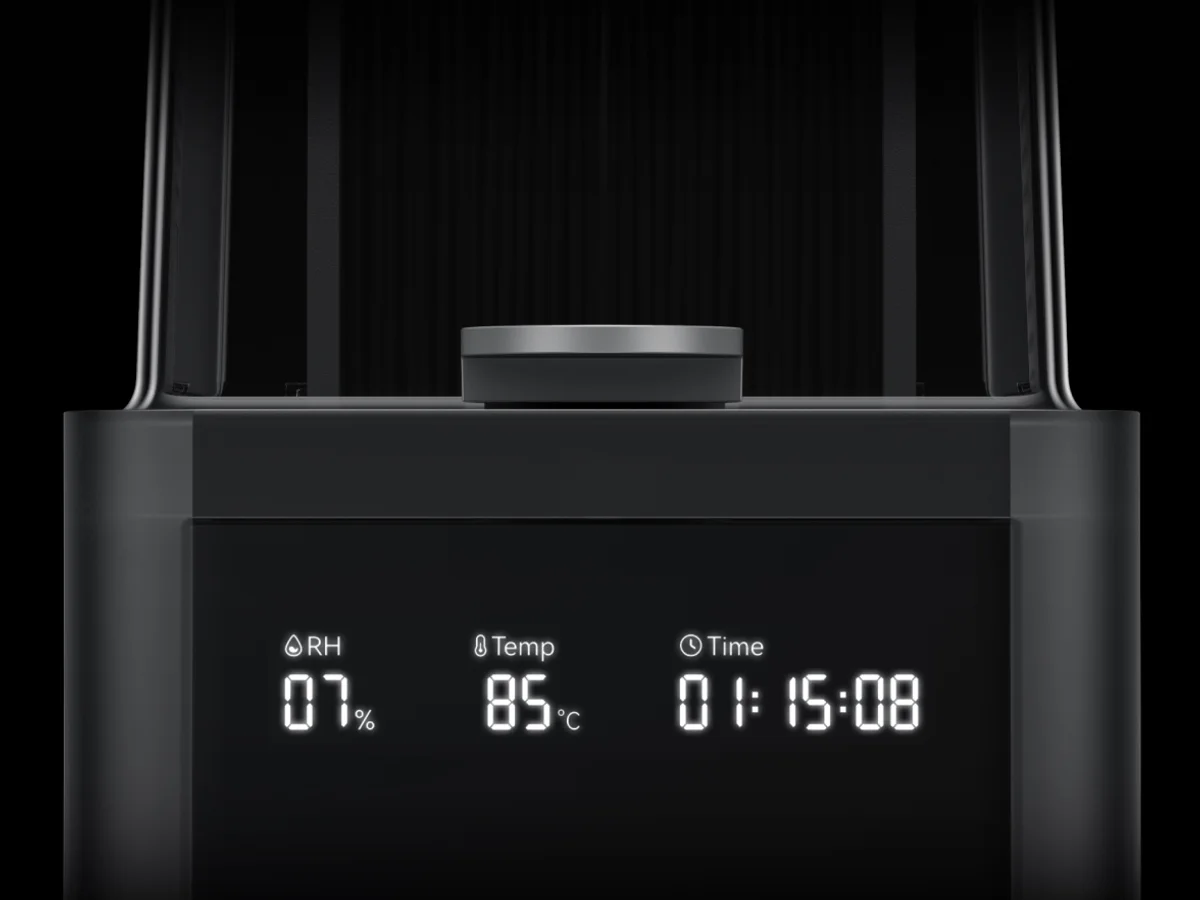
The limits: a dryer costs money, takes a socket and keeps one or four spools warm. If you print one spool a month, it is more than you need.
The printer’s heated bed
On an enclosed printer, the heated bed can dry a spool. You put the spool in a box, set the bed temperature and the time for the filament, and turn the spool over every 6 hours. The maker gives 12 hours for both, at 60 to 70°C for PLA and 75 to 85°C for PETG. Afterwards, wait 5 to 10 minutes and seal the spool straight away.
Three limits. It works only on an enclosed printer: open-frame ones cannot dry filament this way. It ties up the printer for the whole time. And the spool has to take the heat, since some third-party and 3D-printed spools may deform.
Our rental printers include open-frame and enclosed models. If you plan to print TPU or nylon on a rented one, ask us before you book.
The kitchen oven: the risky one
Makers do publish oven settings, so it can be done. Prusa also lists the catches. A home oven is not precise, and swings that do not hurt a roast can damage filament, PLA most of all. Many home ovens cannot be set low enough to dry filament without harming it, even for less time than the table says.
If you try it anyway, Prusa says to use an external thermometer to check the real temperature. Our advice is to spend the money on a dryer first.
Keep it dry afterwards
Drying is wasted if the spool goes back on the shelf. One maker’s data sheet for its PLA says to store and print it below 20% relative humidity, sealed with desiccant. Prusa suggests a closed box with desiccant, or a vacuum bag with desiccant inside, and says to protect the most hygroscopic spools first.
After a drying run, seal the spool in a box or bag while it is still dry, with desiccant, and use it soon.
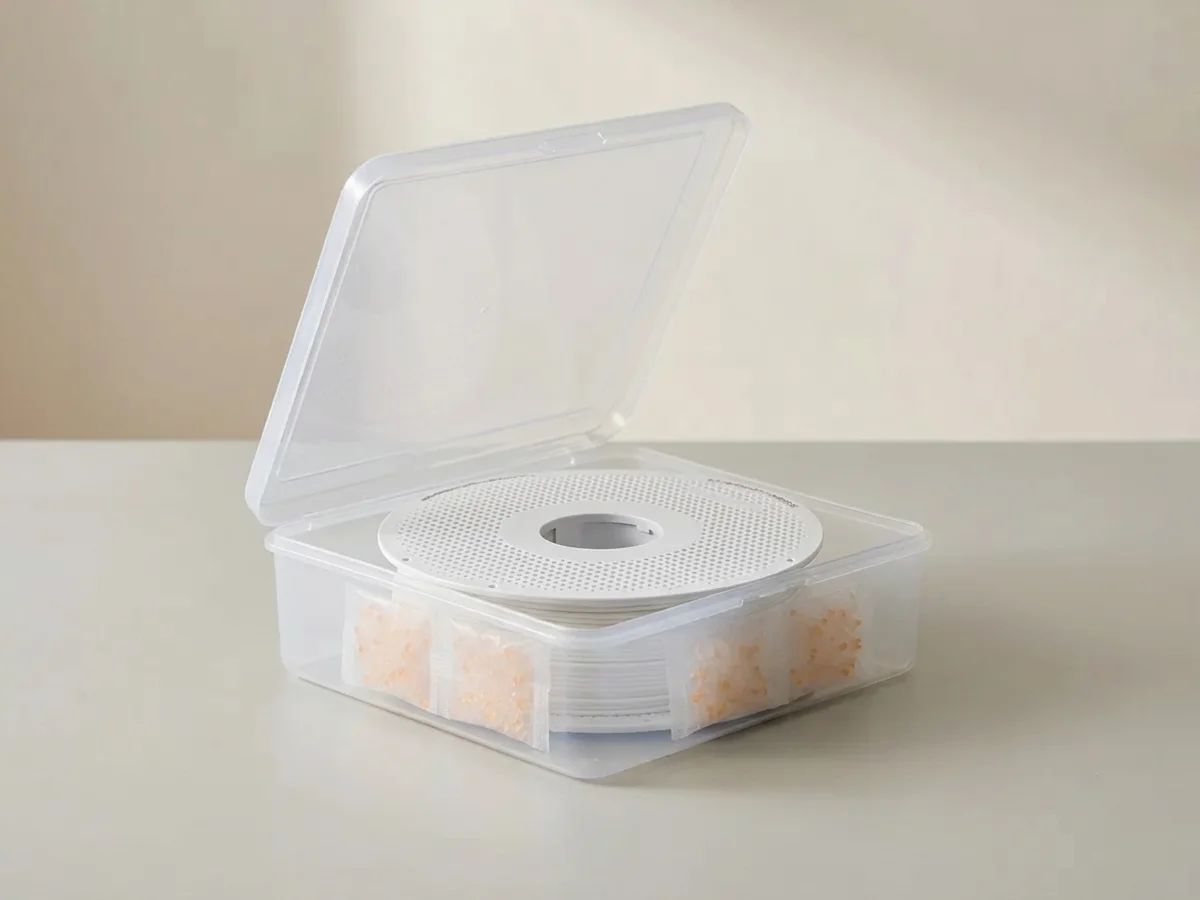
Our store sells silica gel and molecular sieve sachets, six to a pack. The silica gel is the colour-changing kind, and you can dry it out and use it again.
Or let us print it
If you would rather not manage any of this, send us the file. We dry filament before printing, and a person checks every file before it prints. Our guide to printing at home in Singapore covers the rest of living with a printer here, and flexible TPU explains the grade that most needs drying.
Where these facts come from
Every outside fact was read on the source’s own page on 19 November 2026. Drying settings are for one maker’s own filament and change between makers, so check your spool.
- Meteorological Service Singapore, Climate of Singapore: humidity figures.
- Prusa, Drying filament: hygroscopic filament, which materials need drying, the settings table, dryers, ovens and storage.
- The printer maker’s wiki, Filament Drying Recommendations: signs of wet filament, which filaments are required or recommended, heated-bed drying, dryer limits and drying while printing.
- The filament maker’s PLA technical data sheet: storage humidity.
- What we sell and do comes from our own store pages and our blog on print problems.
Frequently asked
Can wet filament still print?
Sometimes, but the print pays for it. One maker lists stringing, oozing, rough surfaces, holes, poor layer adhesion and reduced strength, and in bad cases clogs and feeding trouble. A wet spool that prints is not a good spool for a part that has to hold.
Do I need to dry a new, sealed spool?
Check the filament. One maker's table marks TPU, PC, PVA and the nylons as required before use, and PLA and PETG as recommended. Dry the required ones before the first print. For PLA and PETG, dry first if you cannot tell how the spool was stored.
Can a dryer work while the printer is printing?
Some can. One maker says its dryer lowers its own temperature once a print starts, to stay under the softest filament inside. Drying PETG while printing PLA, for example, drops the setting to 45°C.
Why do different makers give different drying times?
The drying container changes the result. One maker says its parameters vary with the container, and another warns to keep to its stated times to avoid overdrying. Use the figures for your own spool and your own dryer.
Is a 65°C dryer enough for nylon?
No. One maker says a 65°C unit may not dry anything that needs a higher temperature completely, and its table marks TPU, PC and nylon that way. Nylon needs a dryer that reaches 80 to 90°C.
Will the spool melt or warp in a dryer?
It can. One maker warns that some third-party spools, and 3D-printed spools, may not withstand high temperatures and may deform. Check the spool before you set a high temperature, and never exceed the filament's own limit.
Do you dry filament before printing my order?
Yes. We dry filament before printing, and a person checks every file before it prints.
Can desiccant sachets be reused?
Colour-changing silica gel can: dry it out and it works again 5 to 15 times, according to our store listing. Molecular sieve sachets absorb harder but are best treated as replace-when-spent.
Related
-
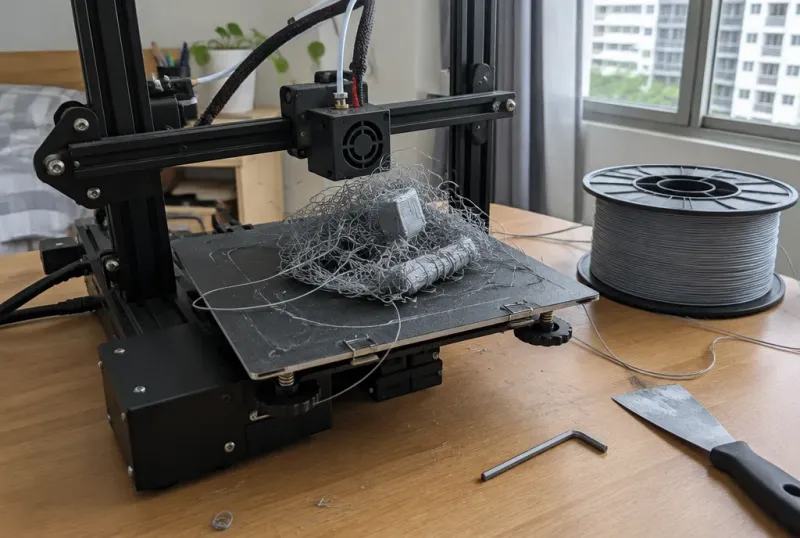 GuideWhat are the most common 3D printer problems, and how do you fix them?
-
 GuidePLA, PETG, ABS, ASA or TPU: which filament should your part be printed in?
-
 GuideWhich filament (FDM) print defects can you fix in the design?
-
 ServiceIndustrial 3D Printing
-
 Service3D Modelling, CAD and 3D Scanning
-
 ServiceProduction Runs & Reverse Engineering
-
 Project3D printing filament rig for recycled PET bottles
-
 Project3D printed electronics enclosure (FDM)
-
 Project3D printed keyboard case and plate for a private client