

Vacuum Forming in Singapore
Thin plastic shells formed over a mould: trays, covers, packaging inserts, enclosure shells and sign faces. We 3D print the mould for short runs, so there is no tooling to buy.
- Lead timeQuoted per job
- QuoteSame business day
Same-day reply. No obligation.
What we make
- 01
Trays & inserts
Packaging inserts and trays that hold parts in place
- 02
Covers & domes
Lids, guards and display covers, clear sheet included
- 03
Enclosure shells
Light outer casings for devices and prototypes
- 04
Sign faces
Formed panels with raised lettering or logos
- 05
Printed moulds
We 3D print the mould for short runs, no tooling to buy
Read first
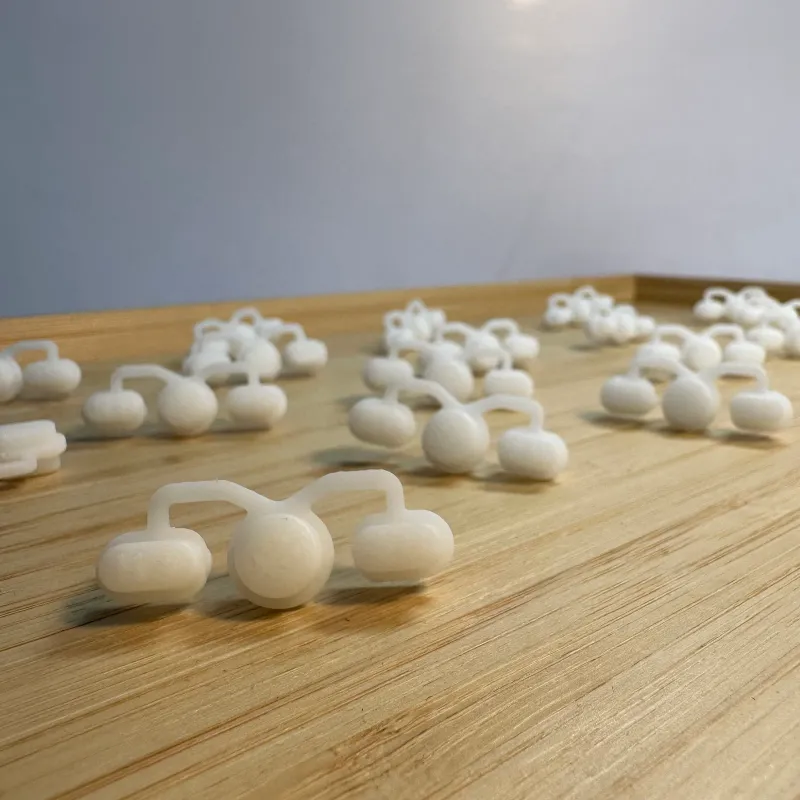
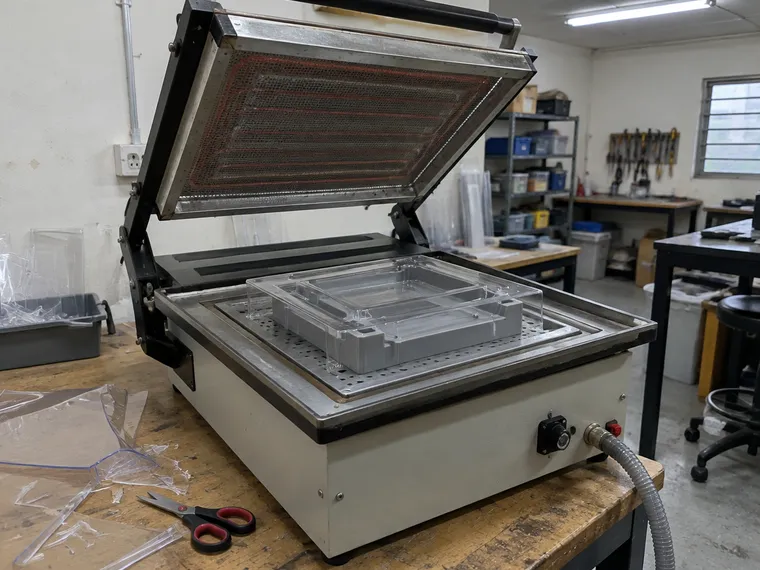
Vacuum forming turns a flat plastic sheet into a thin shell. A sheet is heated until it is soft, laid over a mould, and suction pulls it tight against every surface. Once it cools, we trim it free. The result is a light, even shell: a tray, a cover, a packaging insert, an enclosure shell or a sign face. For short runs we 3D print the mould ourselves, so there is no tooling to buy.
| What you need to know | Vacuum forming at Additive Inn |
|---|---|
| What it makes | Thin shells, open on one side: trays, covers, packaging inserts, enclosure shells, sign faces |
| The mould | 3D printed by us for short runs, smoothed so it does not mark the sheet |
| Sheet plastics | Common sheet such as PETG, HIPS, ABS, acrylic and polycarbonate. Ask us which suits your part |
| Size and quantity | Tell us the size and how many you need, and we confirm |
| Lead time | Quoted per job |
| Not suited to | Solid parts, and shapes with undercuts that would lock the sheet onto the mould |
When to choose vacuum forming: thin shells in a short run
Pick vacuum forming when the part is a shell rather than a solid, and you need more than one:
- Trays and packaging inserts: pockets that hold products, tools or parts in place.
- Covers and domes: lids, guards and display covers, including clear ones.
- Enclosure shells: light outer casings for a device or a prototype.
- Sign faces: a formed panel with raised lettering or a logo, for signs that stand out from the wall.
Each shell is formed from one even sheet, so it is light and consistent from piece to piece.
The mould: we 3D print it for short runs
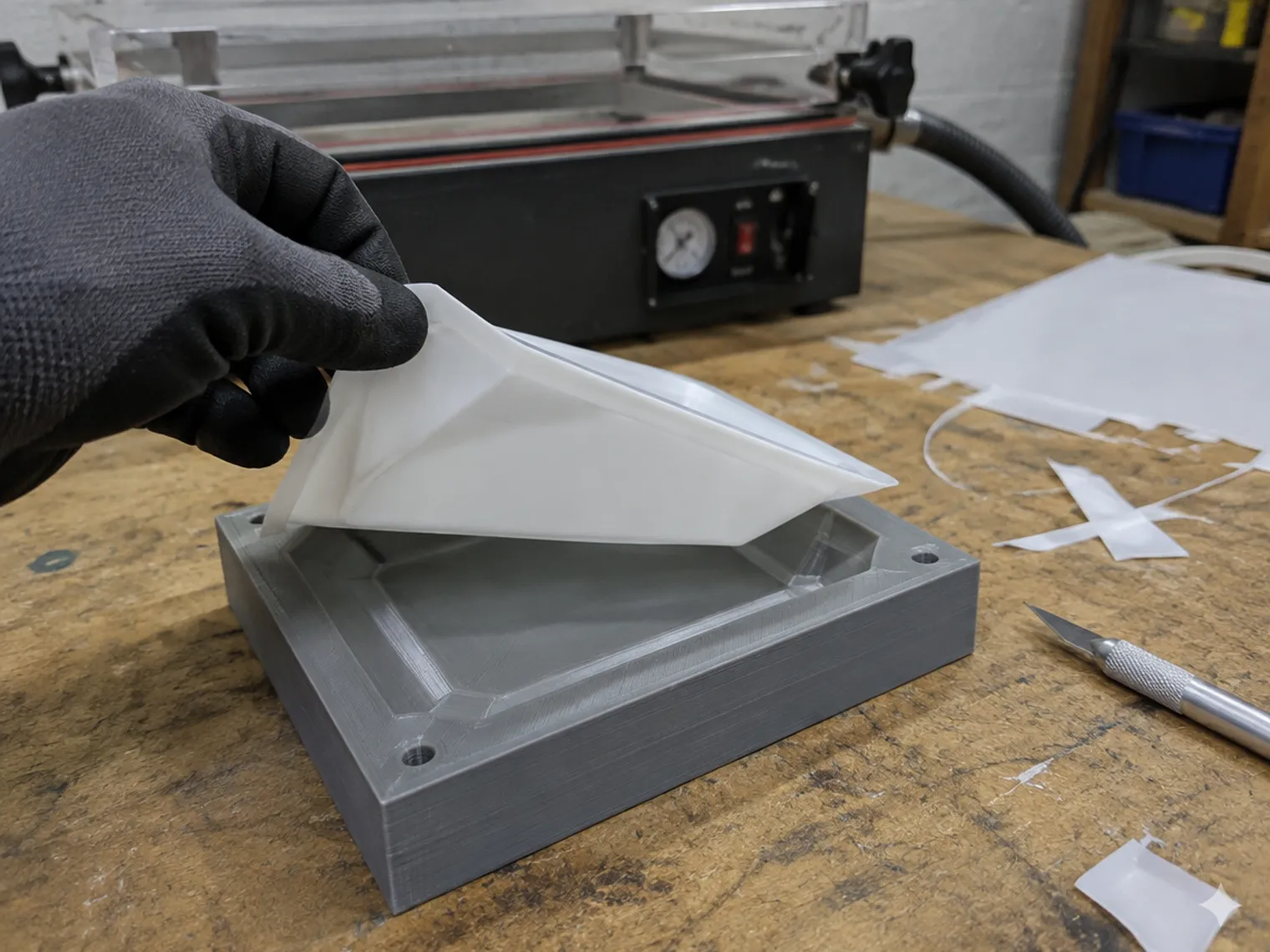
Every vacuum formed part needs a mould, often called a buck. For a short run we 3D print it in house, which is quicker and far cheaper than a machined tool. We give the sides a slight taper so the sheet lets go, and we smooth the surface, because any layer lines on the mould show through on the formed part. Send a drawing, a 3D file or a sample, and we design the mould from it.
Sheet plastics: common grades, ask us for the right one
We form common sheet plastics such as PETG, HIPS, ABS, acrylic and polycarbonate. Some are stiffer, some are tougher, and some stay clear for covers and domes. The right choice depends on what the part has to do, so tell us how it will be used and ask us which sheet suits it.
Not sure vacuum forming fits: send the part and we recommend a method
Vacuum forming only makes shells. If your part has to be solid, has undercuts, or needs fine detail on both faces, it is better made another way:
- A one-off or a few solid parts: 3D printing.
- Up to a few hundred identical solid parts: silicone moulding.
- A flat clear or coloured panel: laser-cut acrylic.
- Thousands of parts: injection moulding, which we arrange for you.
Our guide to 3D printing, silicone moulding and injection moulding compares those routes side by side.
Talk to us with a drawing, a 3D file or a sample, plus the size and how many you need, and we confirm whether vacuum forming is the right fit and send a price.
What's included
- Trays, covers and packaging inserts
- Enclosure shells and display covers
- Sign faces and raised lettering panels
- Moulds (bucks) 3D printed by us for short runs
- Common sheet plastics, including clear sheet
- Trimmed to shape and checked before delivery
How we make it
-
Send the part
Share a drawing, a 3D file or a sample of the part, with the size and how many you need. We confirm whether it suits vacuum forming.
-
Make the mould
We 3D print the mould (the buck) with a slight taper so the sheet lets go, then smooth it so its surface does not show through.
-
Heat & form
A plastic sheet is heated until soft, laid over the mould, and a vacuum pulls it tight against every surface.
-
Trim & finish
Each formed shell is cut free of the sheet, holes and edges are trimmed, and the part is cleaned.
-
QC & deliver
Parts are checked against the mould and the drawing before packing. Collect from Bendemeer or have them couriered islandwide.
Frequently asked
What is vacuum forming?
Vacuum forming heats a sheet of plastic until it is soft, then pulls it down over a mould with suction so it takes the mould's shape. Once it cools, the formed sheet is trimmed into a thin, open shell such as a tray, a cover or a packaging insert. It suits shapes that are open on one side, not solid parts.
What can you make with vacuum forming?
Vacuum forming makes thin plastic shells: trays, covers, packaging inserts, enclosure shells, display domes and sign faces with raised lettering. Every one is open on one side and follows the shape of the mould. If your part has to be solid, or has undercuts that would lock the sheet onto the mould, we suggest 3D printing or silicone moulding instead.
Do I need to supply the mould?
No, we 3D print the mould (often called a buck) for you. For short runs a printed mould is quick to make and costs far less than a machined tool. We give it a slight taper so the sheet releases, and smooth its surface so layer lines do not show through on the finished part.
Which plastics can you vacuum form?
We form common sheet plastics such as PETG, HIPS, ABS, acrylic and polycarbonate, including clear sheet for covers and domes. The right one depends on how stiff, tough or clear the part needs to be. Tell us what the part has to do and ask us which sheet suits it.
How big can a part be, and how many can you make?
Tell us the size and quantity and we confirm what we can do. Size depends on the sheet and the mould, and very deep shapes stretch the sheet thin, so we check each part before we quote. Short runs are what a 3D printed mould is best at.
How long does vacuum forming take, and how do I get a price?
Lead time is quoted per job, because it depends on the mould, the sheet and the quantity. Send a drawing, a 3D file or a sample through the contact form or WhatsApp, with the size and how many you need, and we come back with a price and a timeline.