

What is MDF board, and is it the right sheet for your project?
MDF board is wood fibre pressed with resin. How it differs from plywood and chipboard, how it copes with Singapore humidity, and what E1 means.
How many MDF pieces from one board, and what do they weigh?
Enter your piece size and quantity.
Weight uses 727 kg a cubic metre, the oven-dry density in an MDF industry environmental declaration. Board with normal moisture weighs a little more. Layout is a simple grid with 5 mm between pieces; a cutter may fit a few more.
Medium-density fibreboard (MDF) is a sheet pressed from wood fibre, wax and resin. Its face is smooth with no grain, so it takes paint and cuts evenly. It can swell when it gets wet, and a screw driven into its edge can split it. We laser cut MDF from 3 mm to 12 mm for model bases and architectural parts.
MDF, plywood and chipboard compared
| Board | Made from | How it compares | Our laser |
|---|---|---|---|
| MDF | Wood fibre, wax and resin, pressed flat | Smooth, no grain, no knots. Denser than plywood, stronger than chipboard | Cuts it, 3 to 12 mm |
| Plywood | Thin wood veneers glued in layers | Real wood grain through the face | Cuts it, 3 to 12 mm |
| Particle board (chipboard) | Wood chips and resin | The weakest of the three, chosen when cost matters more than strength | Not on our cutting list: ask us |
Chipboard and particle board are two names for one sheet. MDF is typically 600 to 800 kg per cubic metre, and particle board 500 to 800. Our plywood types guide covers the grades of plywood.
What MDF is made of
A typical board is about 82 percent wood fibre and 9 percent urea-formaldehyde resin glue, with water and a little paraffin wax making up the rest. The wood is broken down into separate fibres first, then pressed under heat. That is why MDF has no knots and no rings, and why it cuts the same way across the whole sheet.
The resin is the part to know about. It is the reason for the formaldehyde rules further down this page.
MDF in Singapore’s humidity
Singapore is humid all year. The Meteorological Service Singapore puts the average relative humidity, over the whole day, between 80.7 and 85.5 percent in every month (1991 to 2020), and it rains on about 171 days a year.
Bare MDF does not like that. It can warp or expand in humid air if it is not sealed, and low-grade board can swell and break when soaked. It is mainly an indoor board for that reason. Humid-grade MDF exists: the European standard EN 622-5 has a class for humid conditions, called MDF.H.
- Seal every face and edge. Paint or prime all sides, not only the front.
- Keep it off wet places. A shelf or a model base indoors is fine. For a sign outdoors, MDF is the wrong sheet: tell us where it goes, and see our acrylic signage buyer’s guide for what we recommend outside.
Formaldehyde: E1, E0 and CARB in plain words
Formaldehyde is a gas that the resin slowly gives off through the edges and surface. Rules cap how much a board may release in a test chamber.
- E1 (Europe). The standard EN 13986 defines two classes, E1 and E2. A board is E1 if a chamber test finds no more than 0.124 mg of formaldehyde per cubic metre of air, which is 0.1 ppm (parts per million).
- E05 (Europe, from 6 August 2026). An EU restriction under REACH (Regulation (EU) 2023/1464) now halves the limit for wood-based articles placed on the EU market to 0.062 mg per cubic metre. It has exemptions, such as second-hand articles and articles used only outdoors.
- CARB and TSCA Title VI (United States). The two sets of limits are identical. For MDF the limit is 0.11 ppm (0.13 ppm for thin MDF), for particleboard 0.09 ppm and for hardwood plywood with a veneer or composite core 0.05 ppm. The test method differs from the European one, so the numbers are not a direct match.
- E0. You may see this on a label as a stricter class. EN 13986 itself sets only E1 and E2, so ask the maker which test and limit E0 refers to.
Cutting MDF releases a lot of dust, and the formaldehyde it can release may irritate the eyes and lungs when you cut or sand it. The UK Health and Safety Executive treats all wood dust as hazardous. Painting all sides of a finished piece helps seal the formaldehyde in.
We do not state the class of the board we cut on this site. If it matters for your job, ask us before we cut.
Screws, edges and blades
A screw driven into the face of MDF does not split it. The edge is the weak spot: the fibres are pressed in layers, so a screw driven into the edge can split the board unless you drill a pilot hole first. Smooth-shank nails and fine-pitch screws hold poorly, especially in the edge. Coarse-thread screws and sheet-metal screws work better. T-nuts with machine screws are the usual fixing.
MDF also dulls blades faster than many natural woods. A laser has no blade to dull.
What MDF suits
- Model bases and baseboards. A flat, even face is what a model sits on.
- Fixtures and jigs. Our laser cuts MDF for fixtures, fretwork and packaging inserts.
- Painted parts. The face takes paint evenly, which is why it is common as painted interior trim.
- Boxes and panels used indoors. Speaker boxes and shop slatwall are two ordinary uses.
It does not suit wet places, parts screwed into their edges, or anything left outside.
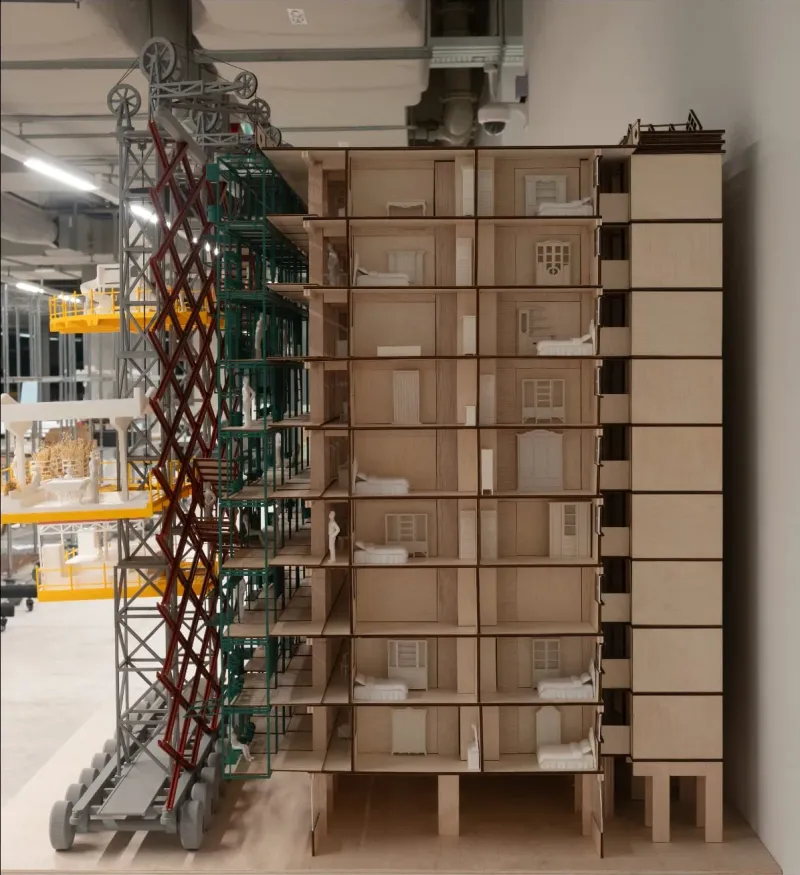
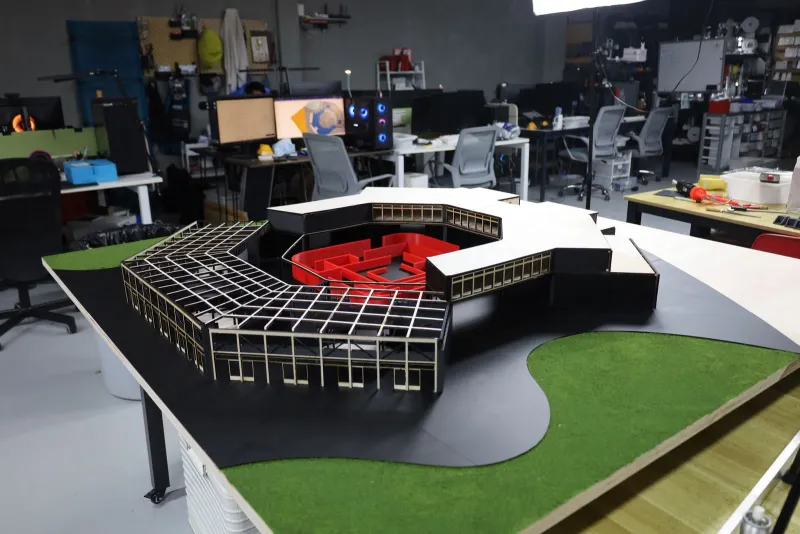
We have no MDF project photo on file, so the two models below show our laser cutting plywood. Our laser cuts MDF and plywood across the same 3 to 12 mm range.
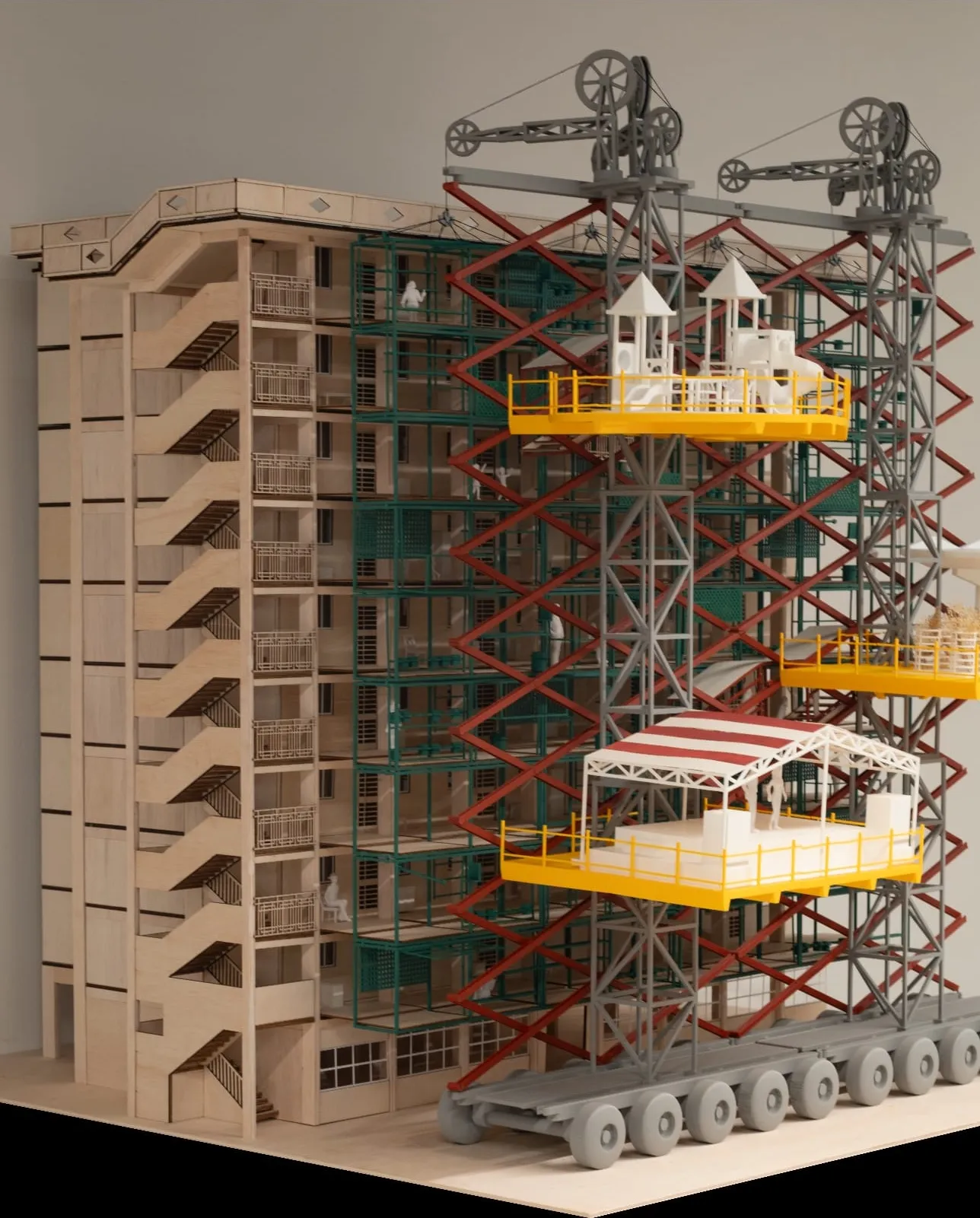
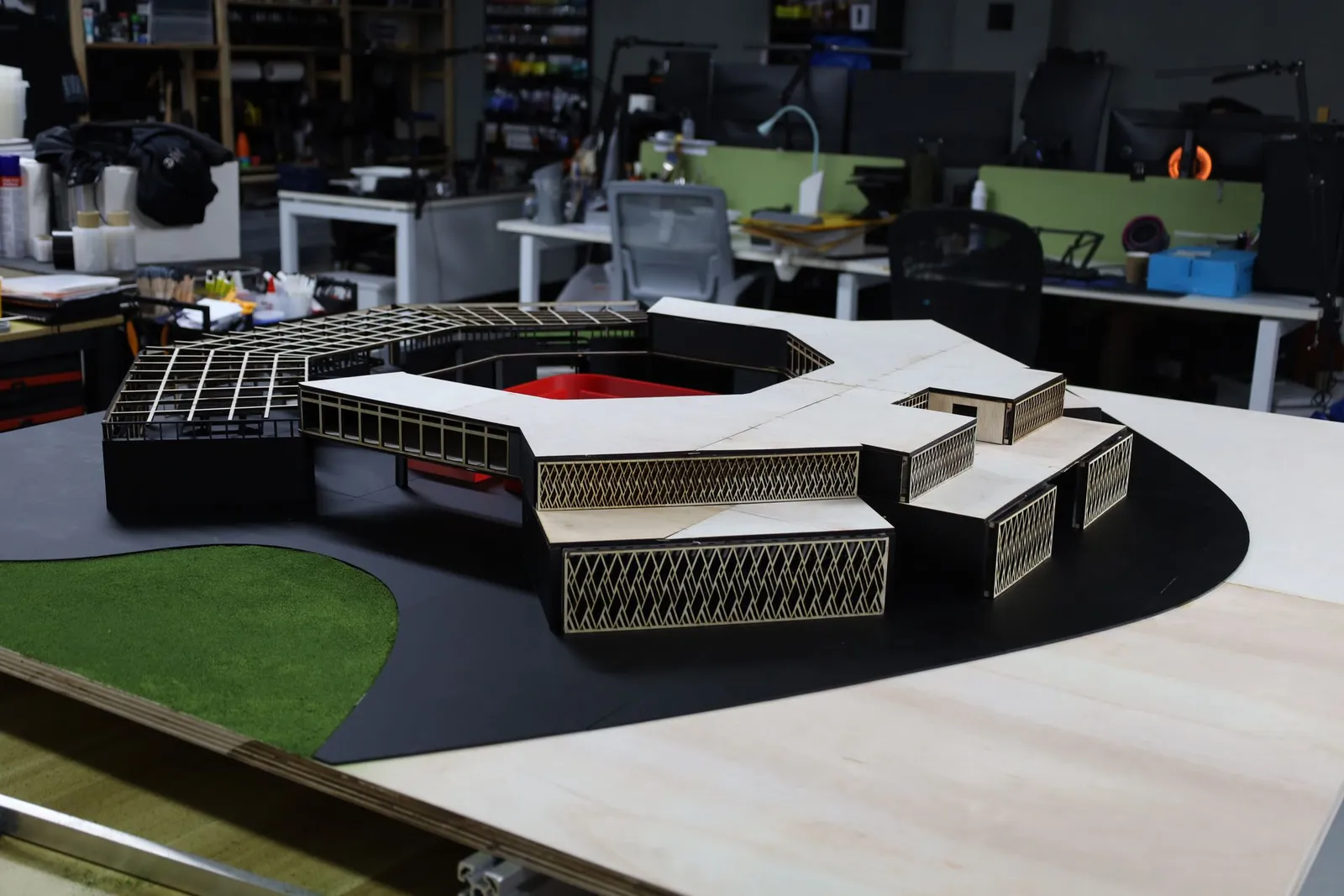
Our laser cutting materials guide lists every sheet we cut, and the laser cutting service page shows what a file needs.
Where these facts come from
Every outside fact on this page was read on the source’s own website on 19 November 2026. Rules change, so check the source before you rely on a limit.
- Wikipedia, Medium-density fibreboard, Particle board and Plywood: what each board is made of, densities, screws, blades, moisture and painting.
- Meteorological Service Singapore, Climate of Singapore: humidity and rain days, 1991 to 2020.
- Health and Safety Executive (UK), Wood dust: Controlling the risks: the health risks of wood dust and why a nuisance dust mask is not enough.
- Measurlabs, Overview of formaldehyde regulations in the EU, and MEDITE SMARTPLY, MDF and formaldehyde: E1 and the 2026 EU limit.
- US Environmental Protection Agency, Formaldehyde emission standards for composite wood products, and the Code of Federal Regulations, 40 CFR 770.10: the US limits, including thin MDF.
- What our laser cuts is from our own laser cutting materials guide.
Frequently asked
What does MDF stand for?
Medium-density fibreboard. The name comes from the distinction in densities of fibreboard: hardboard, also called high-density fibreboard, is the denser grade.
Is chipboard the same as MDF?
No. Chipboard (particle board) is pressed from wood chips, while MDF is pressed from wood fibre. MDF is denser and stronger, and its face is smoother.
Can you use MDF outdoors?
Not usually. MDF is mainly an indoor board because it resists moisture poorly. For an outdoor sign, tell us where it goes and we say which sheet we would use.
Can you laser cut MDF?
Yes. We laser cut MDF and plywood from 3 mm to 12 mm. Send a vector file, say the thickness, and we confirm the sheet before anything runs.
Is it safe to cut or sand MDF at home?
Take care. Cutting and sanding throw off fine dust. The UK Health and Safety Executive treats all wood dust as hazardous, because it can cause asthma and irritate the eyes, nose and throat. It also says a simple nuisance dust mask does not stop wood dust, while a fitted respirator, often rated FFP3, does.
Can MDF be painted?
Yes, it takes paint well, and a sealed edge matters as much as a painted face. Coat every side, not only the front, which also helps seal in the formaldehyde.
Should a model base be MDF or plywood?
For a base you will paint, MDF gives a flat, even face with no grain to show through. Plywood suits a base you want left raw, which is how our architectural models show their timber.
Does MDF come in different formaldehyde grades?
Yes. Boards are sold to different emission classes, such as E1 in Europe. We do not state the class of the board we cut on this site, so ask us if it matters for your job.
Related
-
 GuideWhat can be laser cut, and which material suits your job?
-
 GuideWhich plywood do you need, and where do you buy it in Singapore?
-
 GuideHow is an architectural scale model actually made?
-
 ServiceLaser Engraving & Cutting
-
 Service3D Modelling, CAD and 3D Scanning
-
 ServiceCustom Signage
-
 ProjectLaser-cut architectural concept model for Mitch Teh
- ProjectFaceted laser-cut architecture model
-
 ProjectCore values signage with matching stencils