
What is anodised aluminium, and how do you choose the type and colour?
Anodised aluminium has a grown oxide layer that takes dye. Type II and III, colours, laser engraving, CNC parts and how to look after it.
Which anodised finish do you need?
One or two questions, and you get the finish this guide would start with.
Anodised aluminium is aluminium with a hard oxide layer grown from its own surface, which can be dyed in colour. It is not paint. Ask for Type II when colour is the point, and Type III when the part rubs or wears. The table below gives the answer by job.
Anodised aluminium by job
| What you need | What to ask for | What to know first |
|---|---|---|
| A coloured part, for looks | Type II, dyed | The colour shifts a little between aluminium alloys |
| A part that rubs or slides | Type III, the hard coat | The layer is thicker than 25 µm, so the part grows more |
| A pure white part | Not possible by dyeing | The white dye is too big for the pores |
| A part that sits in sun | Black, or gold made by inorganic means | Reds and blues fade more |
| A part that gets hot | Ask for the heat limit first | Sources disagree on how much heat the layer takes |
| A name on a plate or tag | A dyed plate, laser engraved | The mark comes out light, not bare metal |
| A part that must carry current | A plan for the contact points | The layer insulates |
What anodising is
Anodising is an electrochemical process that turns the surface of a metal into an oxide finish. The Aluminum Anodizers Council says it is not a coating applied to the surface: it is fully integrated with the aluminium under it. The US spelling is anodizing, which is how the Council writes it.
Bare aluminium already grows a very thin oxide skin in air. Anodising makes that skin much thicker. The Council says the finish cannot peel, flake or chip. Wikipedia is more careful: less likely to crack and peel with age and wear than paint or plating, but more brittle.
It does not make the part stronger, and the layer does not conduct electricity. You find it on heat sinks, laptop and device cases, appliance control panels and cookware.
Type II or Type III
The two names come from a US military specification, MIL-A-8625 (now issued as MIL-PRF-8625). The difference is thickness.
- Type II is the moderate layer, about 1.8 to 25 µm. Wikipedia lists the dyed-finish standard, AMS 2472, with the thin layers.
- Type III is the hard coat, thicker than 25 µm. It resists wear better, so it suits parts that slide or rub.
Both grow the part. In typical commercial anodising the oxide builds in and out of the surface by equal amounts, so each face gains half the layer’s thickness. A 2 µm layer adds 1 µm per face. On a tight fit, say so before the part is machined.
Heat is the other limit. The layer expands less than the metal under it, so heat can crack it, though it does not peel. Published heat limits differ widely between sources, so for a hot part, ask for the limit before you order.
Which type we can arrange for your part, we confirm once we see the drawing.
Colours and what they do
The layer is full of tiny pores, and a dye soaks into them. A sealing step then closes the pores to hold the dye in. The Council says the dye stays locked in the pores.
- The common colours are yellow, green, blue, black, orange, purple and red. Paler shades are harder to make on some alloys.
- Colour depends on the alloy. The same dye can come out a little different on a different grade of aluminium.
- Reds and blues fade more. Black dyes, and gold made by inorganic means, are more lightfast.
- White cannot be dyed in. The molecule is too big to enter the pores.

Laser engraving anodised aluminium
We laser engrave anodised aluminium for plates, tags and product labels. The laser burns the dye out of the surface layer. What is left is the pale oxide underneath, so the lettering reads as a light mark on a coloured plate. A laser maker’s guide says very little of the layer itself is removed.
That is different from engraving on powder-coated steel, where the beam burns through the coating to the bright metal. It is also different from a cutter engraving, which can go through the layer and leave bare metal.
- Best for: names, logos and labels on a dark plate.
- Limit: the mark comes out light. It does not add colour. Ask us if you want fine shading or a photo.
- Buying the plates yourself? Send us a photo or the make and model first, and we confirm the plate takes a clean mark.
Our guide to what laser engraving is shows how it looks on other materials. For a plate on a desk or door, see name plates and name tags.
Anodising CNC parts
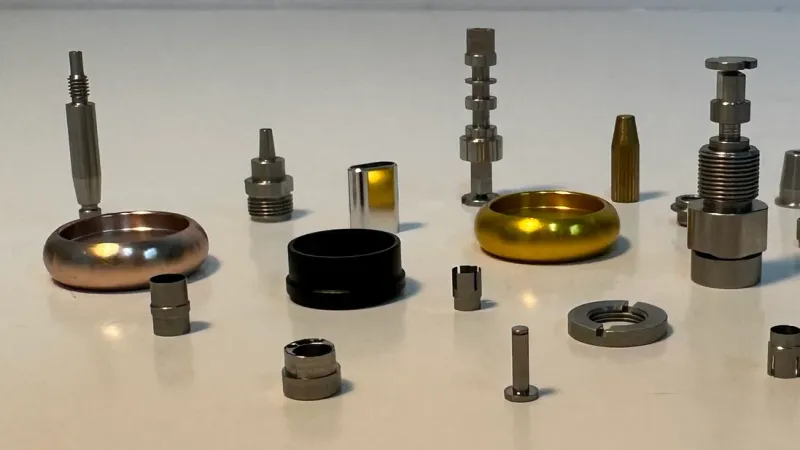
Our CNC machining page lists optional bead blasting or anodising before delivery, with black the usual colour. Titanium can be anodised too, and we have made titanium parts anodised in gold.
Bead blasting first gives an even matt surface under the colour. If you need a different colour, or a hard coat, ask us. Anodising also adds time, so tell us if you have a deadline.
Our CNC machining materials guide covers which metal suits which part. Aluminium 6061 is the usual first choice and takes anodising well.
Looking after it
- Wash it with mild soap and water. A rinse restores the finish, says the Aluminum Anodizers Council.
- Keep strong cleaners off. High and low pH chemistry can dissolve the layer.
- Mind the heat. The layer can crack under heat. For a hot part, ask for its limit first.
- Do not rely on the layer for current. It insulates.
Where these facts come from
Every outside fact was read on the page named below on 19/11/2026. Standards and specifications change, so check the source before you rely on a figure.
- Aluminum Anodizers Council, What Is Anodizing?, Applications and Advantages: what anodising is, where it is used and how to clean it.
- Wikipedia, Anodizing: layer thickness for Type II and Type III, dyeing, sealing, heat and dimension change.
- Trotec Laser, Anodised aluminium help page: what a laser does to an anodised layer.
- Our own services: laser cutting and engraving and CNC machining.
Frequently asked
Does anodising peel or chip like paint?
It is far less likely to peel than paint, because the layer grows out of the metal instead of sitting on it. It is harder than bare aluminium but more brittle than paint, and it can crack if the part gets hot. Wikipedia says a crack does not peel.
Can anodised aluminium be white?
Not by dyeing. The white dye's molecules are bigger than the pores in the oxide layer, so they cannot get in. If a part must be white, ask us which other finish can give it.
Does anodising change the size of a part?
Yes, a little. In typical commercial anodising the layer grows in and out of the surface by equal amounts, so each face gains half the layer's thickness. For a tight fit, ask us before the part is machined.
Why is a laser engraving on anodised aluminium light instead of bare metal?
The laser removes the dye from the oxide layer, and the layer underneath is pale. So the mark reads light against a coloured plate. Bare metal shows only where something cuts right through the layer, which a laser mark usually does not do.
Do some anodised colours fade?
Yes. Wikipedia says some colours, reds and blues, are particularly prone to fading, and that black dyes and gold made by inorganic means are more lightfast. For a part that sits in sun, ask for black or inorganic gold.
Can you anodise stainless steel, brass or a 3D print?
Not through us. Our CNC guide says anodising works on aluminium and titanium, so it is not an option for brass, steel, plastics or wood. If you need a finish on those, ask us what we can do.
Is anodising the same as powder coating?
No. Powder coat is a coating on the surface. Anodising is grown from the aluminium itself. They also engrave differently: on powder-coated steel the laser burns through to bright metal, while on anodised aluminium it leaves a light mark.
Can an anodised part carry electricity?
Not through the finished surface, because the oxide layer insulates. A part that must earth or make contact needs a plan for its contact points, so say so when you ask for the finish.
How do I clean anodised aluminium?
Mild soap and water, then a rinse. Wikipedia says high- and low-pH chemistry can dissolve the layer, so keep strong acids and alkalis, such as drain cleaners and oven cleaners, away from it.
Related
-
 GuideWhich CNC machining material should your part be made in?
-
 GuideWhat is laser engraving, and what can it mark?
-
 GuideWhat name plate suits an office door, a desk, a gate or a machine?
-
 ServiceLaser Engraving & Cutting
-
 ServiceCNC Machining
-
 ServiceSheet Metal Fabrication and Bending in Singapore
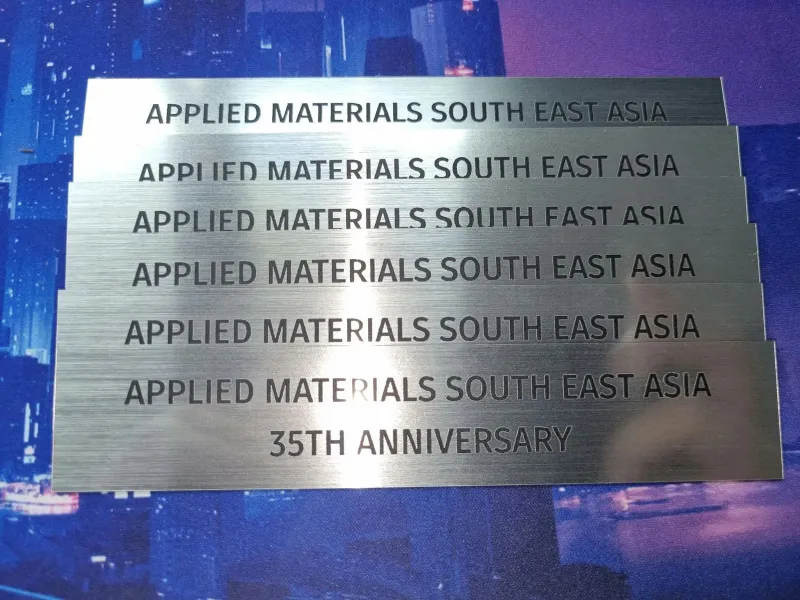
- ProjectSilver equipment nameplates for Applied Materials South East Asia
-
 ProjectSilver labels and black nameplates for Goldwind Services
-
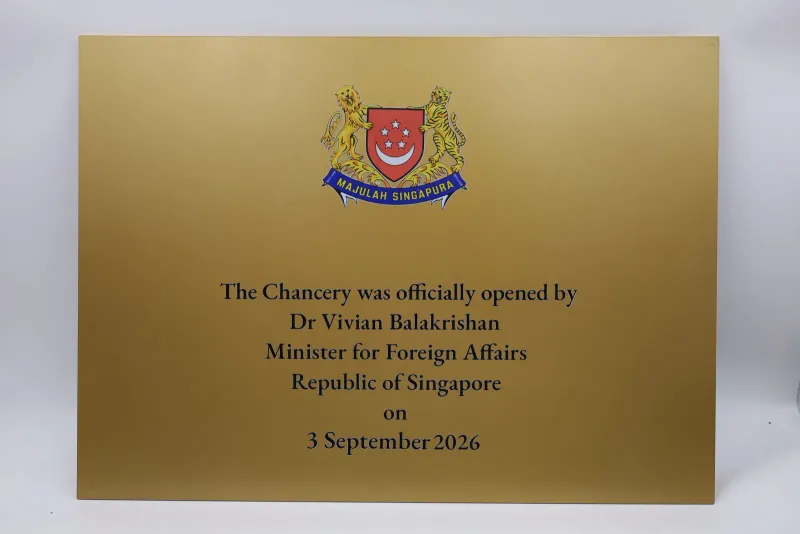 ProjectCommemorative plaque for the Singapore Consulate-General in Johor Bahru