

How do you choose an acrylic display case for a model, figurine or award?
How to choose an acrylic display case for a model, figurine or award: lid or full box, wall thickness, glued or screwed, dust, sunlight and measuring.
What size case does your piece need?
Measure the piece at its widest, deepest and tallest points, including the base and anything that sticks out.
Space around the piece
A cover that sits on a base: four sides and a top. Clearance and thickness follow the acrylic makers' guides quoted in this post, which do not all agree. Weight uses 1.2 kg a square metre for each millimetre of acrylic.
An acrylic display case is a clear cover that keeps dust and hands off a model, figurine or award. Choose the shape by whether you will lift the cover, the wall thickness by the size, and the fixing by whether the case has to come apart. Then measure the piece with its base, and add room round it.
Acrylic display cases at a glance
| Case | Best for | Walls | How it is fixed |
|---|---|---|---|
| Clear lid on a base | Awards, replicas, models you show and sometimes handle | 3 mm on our 470 mm control panel cover | Lifts straight off, with no screws |
| Full clear box | Parts, electronics, anything seen from every side | 3 mm in our example | Screwed together with brackets, or glued |
| Lit case | A scale model with spotlights inside | Set with the size of the model | Clear cover on a black top, lights and wiring in the base |
| Small case on a shelf | A figurine or small model under about 30 cm | 3 mm, says one fabricator | Buy it ready-made, or ask us |
The numbers are for the cases we have made and for what fabricators publish. Makers disagree, so they are a starting point, not a rule.
Clear lid on a base
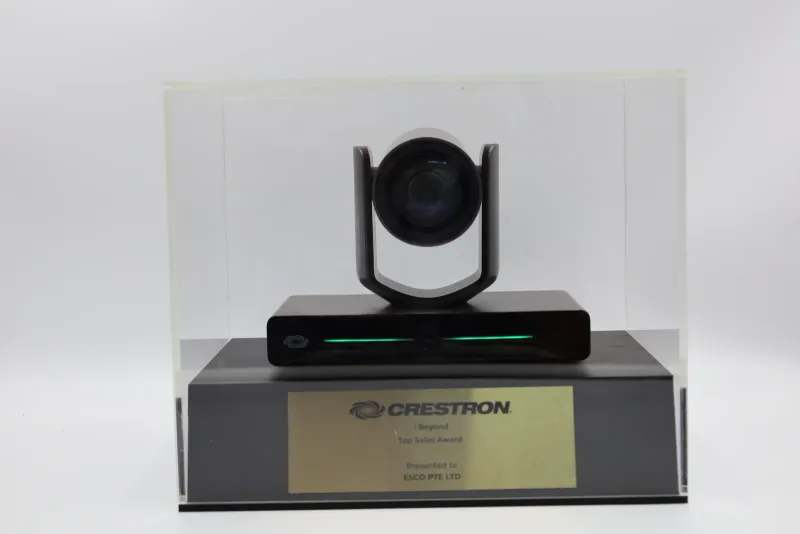
This is the case most pieces want. A base carries the piece, and a clear cover sits over it. You lift the cover to reach what is under it.
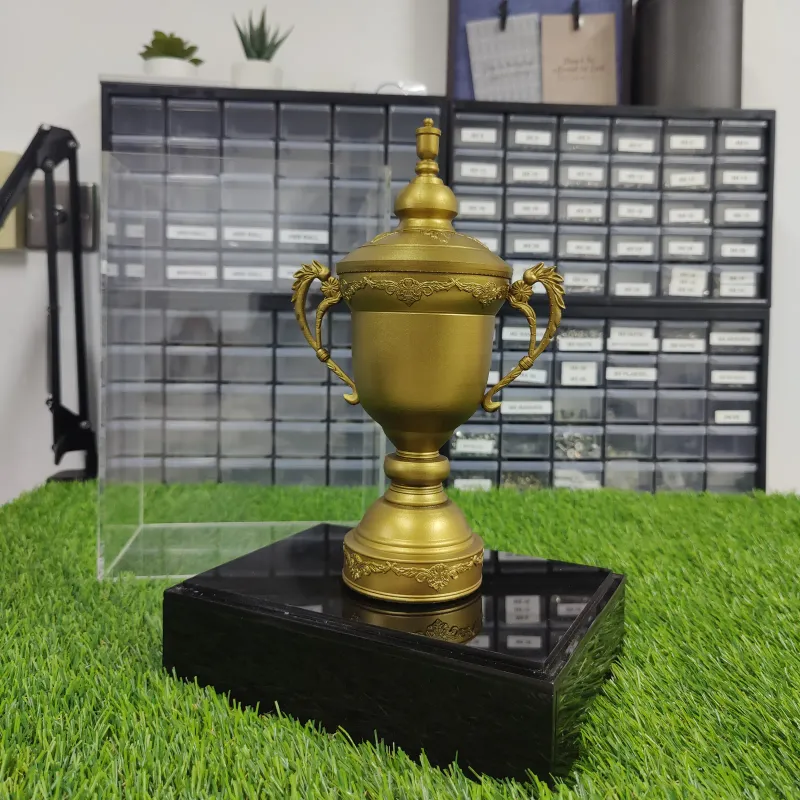
We have made cases this way. Crestron’s camera trophy has a clear case that lifts off the base. FAS’s Congress Cup replica sits on a black base under its own case, with an engraved plate added at FAS’s request. A control panel we mounted has a 3 mm cover that rests on a ledge around its base, with no screws or clips.
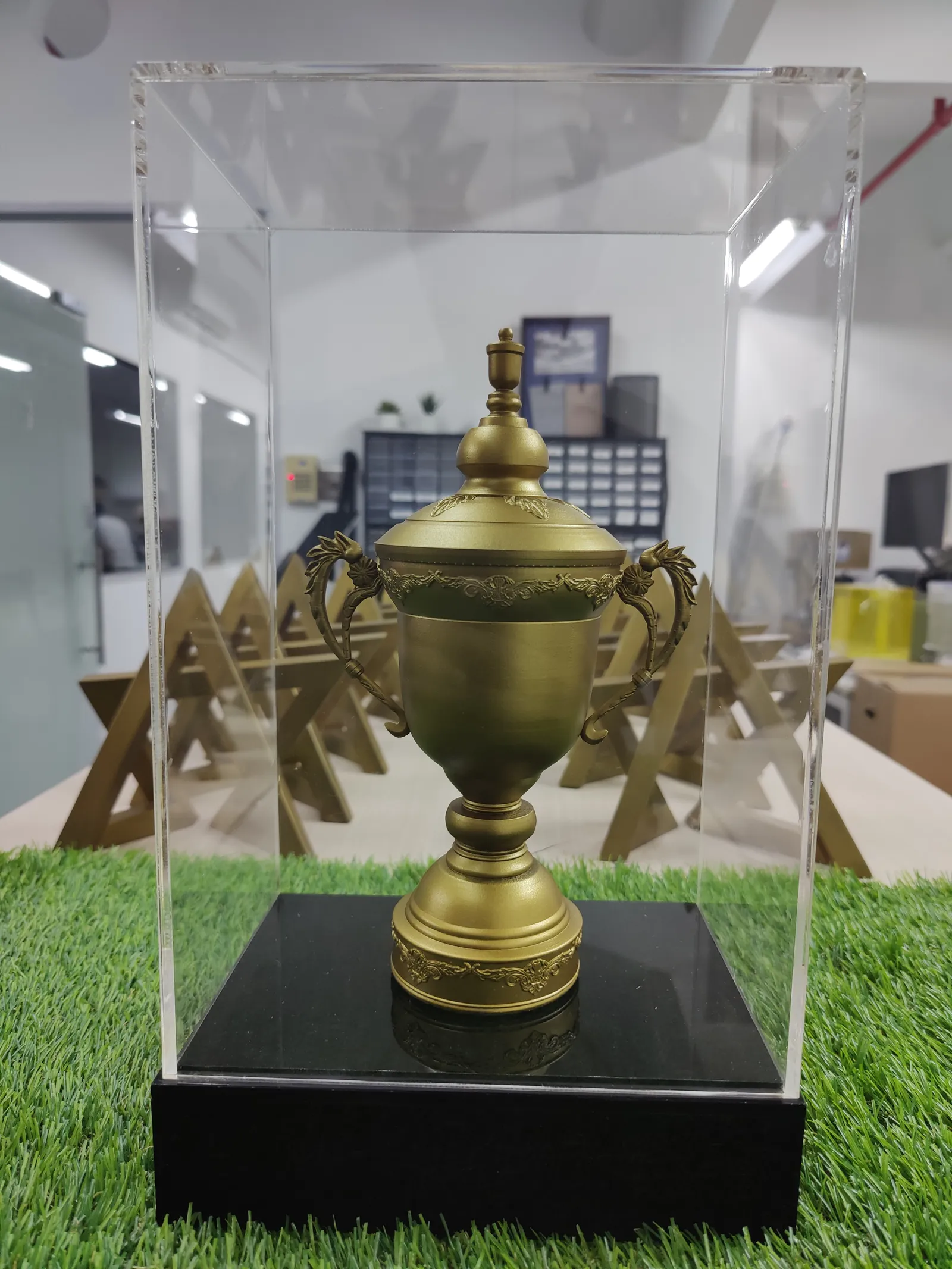

- Pick it when the piece sits on a shelf and someone will want to look closer.
- Limit: the cover is not fixed down, so a knock can shift it. A ledge round the base, as on our control panel stand, keeps it in place.
Full clear box
A box is clear on every side, the bottom too. It suits pieces seen from all round, or pieces with parts to show, like a circuit board.
Our example is two clear cases for a Singapore Institute of Technology project: 3 mm panels with round fan grilles cut into them. Printed corner brackets hold the panels, with a nut in each bracket, so the case screws together and comes apart again. Nothing is glued.
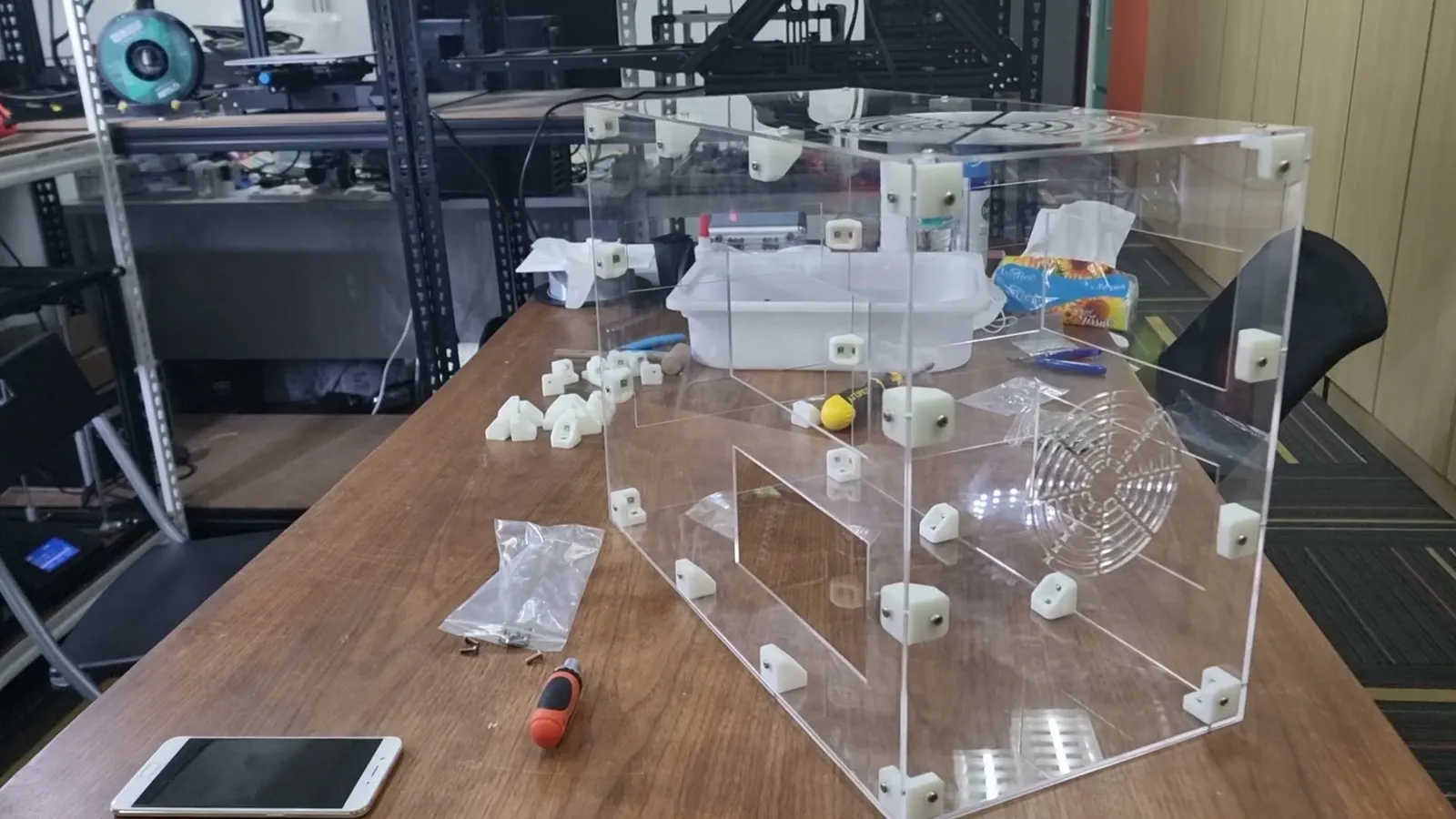
- Pick it when the case is part of an experiment or a product, and may need opening.
- Limit: brackets show on every edge. For a trophy or a model, a lid on a base looks cleaner.
Lit case for a scale model
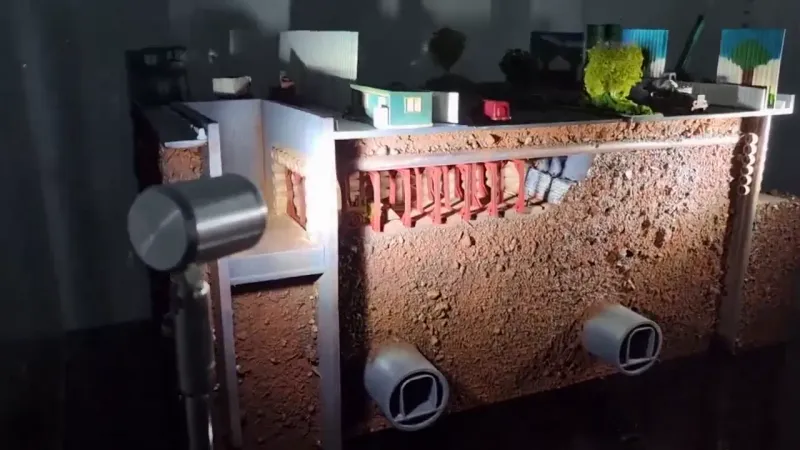
A lit case is a clear cover on a black top, with the lights tucked into a deep base. Our 1:200 MRT construction models for LTA each have one: three cases, with spotlights inside switched on by a button on the base. The plan showed a base 12 cm tall to take the wiring.
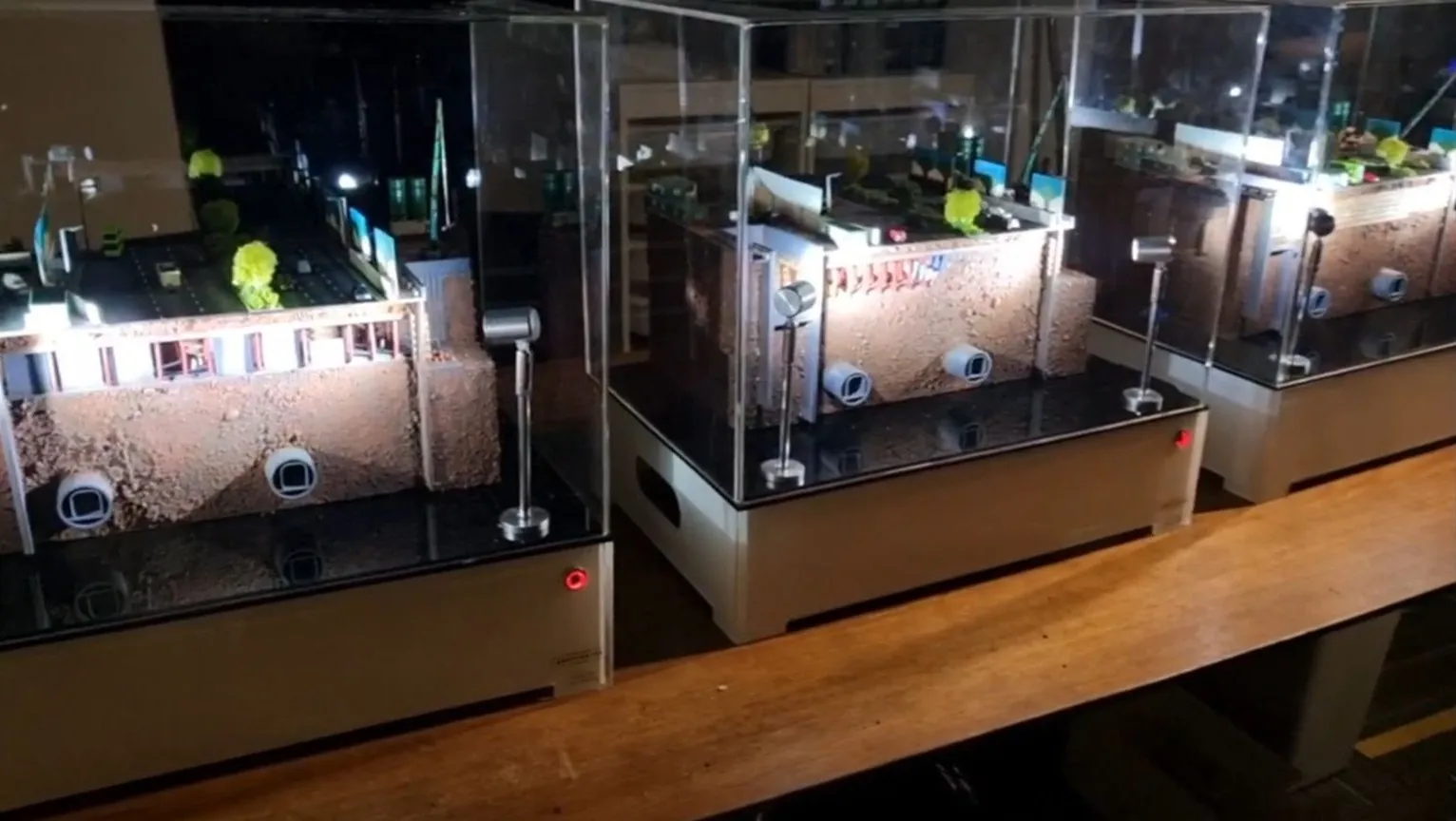
- Pick it for a model that has to read well across a room.
- Limit: lights need wiring, a switch and a deeper base, so plan the case with the model, not after it.
How thick should the walls be?
It depends on the size of the case, not on how precious the piece is. Makers’ advice differs, so read these as a range, not a rule.
- Small, under about 30 cm: Custom-Displays, an acrylic fabricator, says 3 mm is generally sufficient.
- Medium, about 30 to 60 cm: the same fabricator says 4.5 to 6 mm.
- By total size: Acrylic Job, a case maker in California, says 1/8 inch is not thick enough for large cases. Once length plus width plus height passes 40 inches, about a metre, it says to use 3/16 or 1/4 inch, which is roughly 5 to 6 mm. JAYI, a maker in China, gives the same rule.
For scale, our 3 mm control panel cover is about 470 mm long with its base. A larger case may need thicker sheet: ask us.
Thin sheet on a big case bows. Custom-Displays says 3 mm acrylic across a 24-inch span, about 60 cm, often flexes when touched. If you are unsure, go one step thicker.
Glued or screwed?
Acrylic can be joined with solvent cement, which dissolves the faces of the joint. The maker Acrylite says capillary cementing, done properly, gives a strong, transparent joint, and that solvent bonding can reach bond strengths equal to the sheet itself.
Gluing is neat, and permanent. Screws let the case come apart, which matters if the contents change or a panel gets scratched. Our SIT case is screwed, so it comes apart again. A cover that lifts off is the simplest of all.
- Glue a case that will never be opened.
- Screw a case you may open or ship flat.
- Lift-off for a trophy or a model: no fixing at all.
Dust and sunlight
The case keeps dust off what is inside. Acrylic can pick up a static charge, and static attracts dust back onto the outside. Acrylite says dry or gritty cloths can scratch the sheet and add to that charge. Dust with a soft damp cloth, and use an antistatic cleaner after the sheet is dry.
Sunlight fades what is inside. Acrylite says paper and fabric fade or turn yellow in sunlight, and one retailer’s guide says to keep cases away from direct sunlight near windows. A shelf away from the window is the cheapest fix.
Acrylite also makes a UV-filtering sheet, which it says blocks nearly 100% of UV light at 390 nanometres. UV-filtering sheet is not on our list: ask us if a piece has to sit in daylight.
How to measure for a case
Measure the piece in all three directions, including its base, its pose and any parts that stick out. Then add clearance. JAYI, an acrylic maker, suggests 13 to 25 mm on every side for pieces about 8 to 30 cm, and 25 to 50 mm for larger ones. One Singapore retailer’s guide says at least 3 to 5 cm for figurines, which is the generous end.
- Measure the widest point, not the front. Arms, wings and bases are where fit goes wrong.
- The case is bigger than its inside. The outside includes the thickness of the panels, the base plate and any screws.
- Leave room to lift the cover. If it snags on a thin part, the case is too tight.
Send the three sizes and a photo, and we work out the rest.
What we make
Scale models and figurines are our own work, and the case is part of the job: our scale models page lists delivery and set-up with a display case if the model needs one. Our trophy service lists custom presentation cases. A Mini Me figurine has a clear dome sized to the figure, on the custom figurines page.
A case on its own, without a model, is a question to ask us.
Where these facts come from
Every outside fact was read on the page named below on 19 November 2026. The thickness figures are fabricators’ advice, which differs from maker to maker, not a standard.
- Custom-Displays, What acrylic thickness should I use for a display case: thickness by case size and the 24 inch span. Acrylic Job, Custom size display case and JAYI Acrylic, How thick is the acrylic display case: the 40 inch rule.
- JAYI Acrylic, How to choose the right acrylic display case size for collectibles: measuring in three directions and clearance.
- Lazada Lighting and Decor, How to choose the right size acrylic display case for figurine scales: the retailer’s clearance figure, the outside size, and keeping cases from direct sunlight. It is a retailer’s blog, so no thickness figure here rests on it.
- Acrylite, Cementing and what is solvent bonding: solvent cement joins.
- Acrylite, Clean, disinfect and maintain and why use UV filtering sheet: static, dust, cleaning, and UV and fading.
- Wikipedia, Inch: 25.4 mm, for the inch conversions.
- First-party facts (our cases, the Mini Me dome, the scale models page) are from our own project and service pages, listed in the facts file for this post.
Frequently asked
What is the difference between an acrylic display case and an acrylic box?
Shops use the words loosely. In this guide a box is clear on every side and a case is a clear cover that lifts off a base. The useful question is whether you need to get at what is inside: if you do, choose a lifting cover.
How much space should I leave inside the case?
One acrylic maker's guide says 13 to 25 mm on every side for pieces about 8 to 30 cm, and 25 to 50 mm above that. A Singapore retailer's guide says 3 to 5 cm for figurines. Take the generous end for a model with fine parts: a tight fit makes lifting the cover risky.
Can you engrave a plate for the case?
Yes. For the FAS replica cup we added an engraved plate for the case at their request. Tell us the wording and where it should sit.
Can a display case be lit?
Yes. Our MRT construction models for LTA each sit in a clear case with spotlights inside, switched on by a button on the base. The lighting and wiring go into the base, and the case is planned with it.
Do the walls need to be thick?
Only as thick as the size needs. Our 3 mm control panel cover is about 470 mm long with its base. Bigger cases need thicker sheet, and the makers' published guides step up with size, though they do not agree on where.
Will the case scratch?
It can. Wipe it with a soft damp cloth, not a dry or gritty one, and keep window cleaning sprays away from it. A dry wipe also builds static, which pulls dust back onto the clear surface.
Can you make a case for a Mini Me figurine?
Every painted Mini Me comes under a clear dome sized to the figure. On the Colour Print style it is an add-on. Paint your own kits do not take one.
Can I order just the case, without a model?
A case on its own is not on our list, so ask. Send the size and a photo of what goes inside and we say yes or no.
Related
-
 GuideWhat should you know before you buy an acrylic sheet in Singapore?
-
 GuideHow is an architectural scale model actually made?
-
 GuideHow does custom 3D figurine printing from a photo work in Singapore?
-
 ServiceCustom 3D Figurines
-
 ServiceCustom Trophies & Awards
-
 ServiceLaser Engraving & Cutting
-
 ProjectCamera trophy for Crestron
-
 ProjectCongress Cup replica trophy for FAS
-
 ProjectMRT construction diorama for LTA