
What is a 3D pen, and is it the same as a 3D printer?
A 3D pen draws with melted plastic by hand. Low-temperature and heated pens, the age each maker gives, and how a 3D pen differs from a 3D printer.
On this page
- 3D pen types and ages
- How a 3D pen works
- Low-temperature pens: for young children
- PLA and ABS pens: for older children and adults
- Professional pens: for teens and adults
- What kids make with a 3D pen
- 3D pen or 3D printer
- At school: the pen station on our learning journey
- Where these facts come from
- Frequently asked
A 3D pen, a printer or a workshop?
Two questions, and you get what this guide would pick for your child.
A 3D pen is a handheld pen that melts plastic and pushes it out of a nozzle, so you draw shapes that harden as they cool. It is not a 3D printer: you move the pen, not a machine. Pens differ by temperature and by the age their makers give, so check both.
3D pen types and ages
| Pen type | Plastic it takes | Age the maker gives | Heat |
|---|---|---|---|
| Low-temperature pen (3Doodler Start+) | Its own Start+ strands only | 6 to 13 | Kid-safe temperatures, no external hot parts |
| Low-temperature pen (myFirst 3dPen Make) | Low-heat polycaprolactone (PCL) filament | Listings vary: check the box | Low heat |
| Standard-filament pen (myFirst 3dPen Artist) | Polylactic acid (PLA) and acrylonitrile butadiene styrene (ABS) | 12 and up in the manual (its shop page says 8 and up) | 130 to 230 °C |
| Standard-filament pen (3Doodler Flow) | 1.75 mm PLA and ABS | No age on the page we read: check the box | 160 to 220 °C |
| Professional pen (3Doodler PRO) | PLA, wood, copper, steel and more | 14 and up, keep out of reach of children | Adjustable |
How a 3D pen works
A 3D pen feeds plastic filament (a thin plastic strand) through the pen, melts it and pushes it through a nozzle. The plastic comes out soft, so you have time to shape it before it cools and hardens.
No software is needed: you plug it in, load the plastic and draw. A pen can draw flat on a mat, or lift the line into the air to build something that stands up. A maker advises a non-stick mat or a smooth, heat-resistant surface.
The 3Doodler came out of a Kickstarter campaign launched on 19 February 2013. Its pens use plastics such as PLA and ABS, which desktop printers use too.
Low-temperature pens: for young children
A low-temperature pen is made for younger hands. The maker of the 3Doodler Start+ says it has no external hot parts, runs at kid-safe temperatures and has a fully enclosed nozzle. It still recommends adult supervision. The myFirst 3dPen Make uses low-heat PCL filament.
Pick one for a younger child, and check the maker’s age first. Its limits:
- Its own plastic only. The Start+ works only with its own Start+ strands, so you cannot swap in another spool.
- A grown-up should be near. The Start+ maker says children can use it alone but recommends adult supervision.
PLA and ABS pens: for older children and adults
These pens take 1.75 mm filament. The 3Doodler Flow runs from 160 to 220 °C, and the myFirst 3dPen Artist takes PLA and ABS, and its manual says it is not suitable for children under 12. Pick one for an older child or an adult who wants to choose colours and plastics, within the maker’s age.
Its limits:
- It can burn. The 3Doodler maker warns not to draw on skin with its Create+, PRO+ and Flow pens.
- Temperature must match the plastic. The maker says jams usually come from using the wrong temperature setting for the filament.
- It needs fresh air. The maker recommends a well-ventilated area for all its filaments.
Professional pens: for teens and adults
The 3Doodler PRO is sold for designers, engineers and hobbyists. It takes 1.75 mm filaments including PLA, wood, copper and steel, with adjustable temperature and speed. Its maker says it is for ages 14 and up and to keep it out of reach of children.
It is still a pen. For a part with exact sizes, a printer is the right tool.
What kids make with a 3D pen
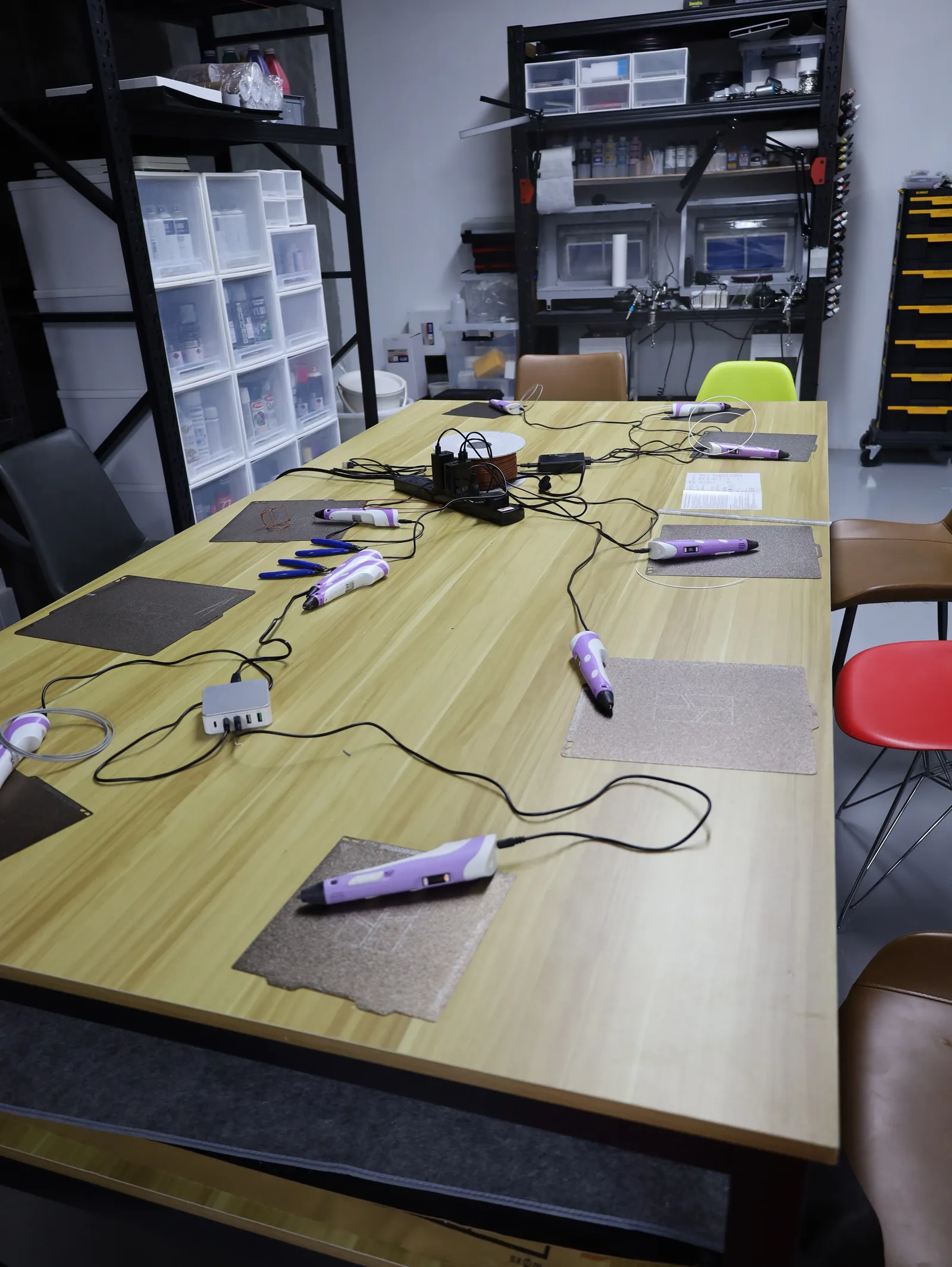
A maker lists jewellery and zipper tags, sculptures, architectural models, and useful things like phone stands. At our station, students draw a shape flat on a mat, then lift it into the air to build a small object.

A pen can also mend a 3D print. A maker says you can fill gaps, add detail or reinforce a weak point, so long as the filament matches the original. The result is only as exact as your hand.
3D pen or 3D printer
| What you compare | 3D pen | 3D printer |
|---|---|---|
| How the shape is made | You move the pen by hand | The machine follows a file, layer by layer |
| Needs a computer file | No | Yes, such as STL, STEP or OBJ |
| Accuracy | As steady as your hand | Set by the file and the machine |
| Good for | Drawing, models, craft, small repairs | Parts that fit, repeat copies, finished pieces |
| What it teaches | Why printers build in layers | How a digital model becomes an object |
For ideas to print, see our guide to 3D printing ideas. We do not list 3D pens in our store.
At school: the pen station on our learning journey
A 3D pen is one of four stations on our school learning journey, with 3D printing, laser engraving and painting. Students draw shapes flat, then lift them into the air to build a small object. Each place has a pen and a heat-proof mat.
Groups of 9 to 60 rotate through all four stations. Groups of 1 to 8 are taken round together, as time allows.
Where these facts come from
Every outside fact was read on the page named below on 19 November 2026. Makers change ages and ranges, so check the box before you buy.
- 3Doodler, What is a 3D pen? and its FAQ page: how a pen works, safety, filaments, temperature range and burn warning.
- 3Doodler product pages for the Start+ (ages 6 to 13, no external hot parts) and the PRO (ages 14 and up).
- myFirst product pages for the 3dPen Artist (shop page says ages 8 and up) and its user manual (12 and up, 130 to 230 °C), and the 3dPen Make (low-heat PCL).
- Wikipedia, 3Doodler and Polycaprolactone: the 2013 launch, the plastics and the name PCL.
- What happens at our studio comes from our own learning journey guide.
Frequently asked
Is a 3D pen safe for children?
It depends on the pen. One maker's low-temperature pen has no external hot parts and still recommends adult supervision, while the same maker warns that its heated pens will burn skin. Check the maker's age and read the manual before a child holds it.
What age is a 3D pen for?
Makers give different ages: 6 to 13 for one low-temperature pen, 12 and up for one PLA and ABS pen with a display, and 14 and up for a professional pen. One maker's shop page says 8 and up for that PLA and ABS pen, but its manual says it is not suitable under 12, so follow the manual. One heated pen's page names no age in the text we read, so check the box.
Do I need a computer to use a 3D pen?
No. A maker says no software is required: you plug it in, load the plastic and draw. Stencils and apps exist, but the pen works without them. A 3D printer is the one that needs a model file first.
Can I use any filament in any 3D pen?
No. One low-temperature pen takes only its own plastic, and the heated pens take 1.75 mm strands. Even then the pen's temperature has to match the plastic, because the maker says most jams come from the wrong temperature setting for the filament.
How hot does a 3D pen get?
One heated pen runs from 160 to 220 °C, another from 130 to 230 °C, and its maker's professional pen has adjustable temperature. Low-temperature pens run cooler, but we found no figure for them. Never draw on skin with a heated pen.
Can a 3D pen repair a 3D print?
A maker says yes, to fill gaps, add detail or reinforce a weak point, if the filament matches the original. A pen repair will not give an exact size, so for a part that must fit, send us the file and we print a new one.
Can a 3D pen replace a 3D printer?
No. A pen is as steady as your hand, so it suits drawings, models and craft. A printer follows a file, so repeat copies come out alike, which is what a part that has to fit needs.
Do you sell 3D pens?
No, our store does not list them. 3D pens are one of the four stations on our school learning journey, where students draw with one. For a home pen, read the maker's age and temperature notes first.
Related
-
 GuideWhat happens on a 3D printing learning journey for schools?
-
 GuideShould you rent a 3D printer in Singapore, and how does it work?
-
 GuideWhat is additive manufacturing, and how is it used?
-
 ServiceIndustrial 3D Printing
-
 ServiceCustom 3D Figurines
-
 Service3D Modelling, CAD and 3D Scanning
-
 Project3D printed pen holders
-
 ProjectPegboard holder for a precision screwdriver set
-
 ProjectElectronic parts holding jig for Sanwa Intec