

What is a diorama, and what goes into making one?
A diorama is a model of a whole scene, not one object. The kinds, the usual scales, what goes into one and how long our site and trophy dioramas took.
How big will it be at scale?
Enter a real size and see it at the scales dioramas and site models use.
1:50 means the model is 50 times smaller than the real thing. Bars share one scale so you can compare.
A diorama is a model of a scene, not of one object: the ground, the buildings, the vehicles and the people, held at one moment. A model of a building is a single object. Put it on its street, add traffic and a worker in a hard hat, and it becomes a diorama. This guide covers the kinds, the usual scales, what goes into building one, and how long ours took.
Kinds of diorama at a glance
| Kind | What it shows | Scales you will meet | Our own example |
|---|---|---|---|
| Museum diorama | An animal habitat or a historic scene, often full size, with a painted backdrop | Full size, with objects drawn smaller towards the back | None on our site: ask us |
| Hobby diorama | A tank, aircraft, train or figure in a small scene | 1:35 or 1:48 are common, 1:87 for HO model railways | None on our site |
| Site or construction diorama | A real place or a building site, often cut open | 1:200 is a usual architectural scale | MRT construction cutaways for LTA |
| Trophy or gift diorama | The recipient’s own world, in a case | Set by the case and the base | Diorama trophy for SBS Transit |
A diorama or just a scale model?
Wikipedia defines a diorama as a replica of a scene. The scene is the point. A scale model can be bare and still be a good model.
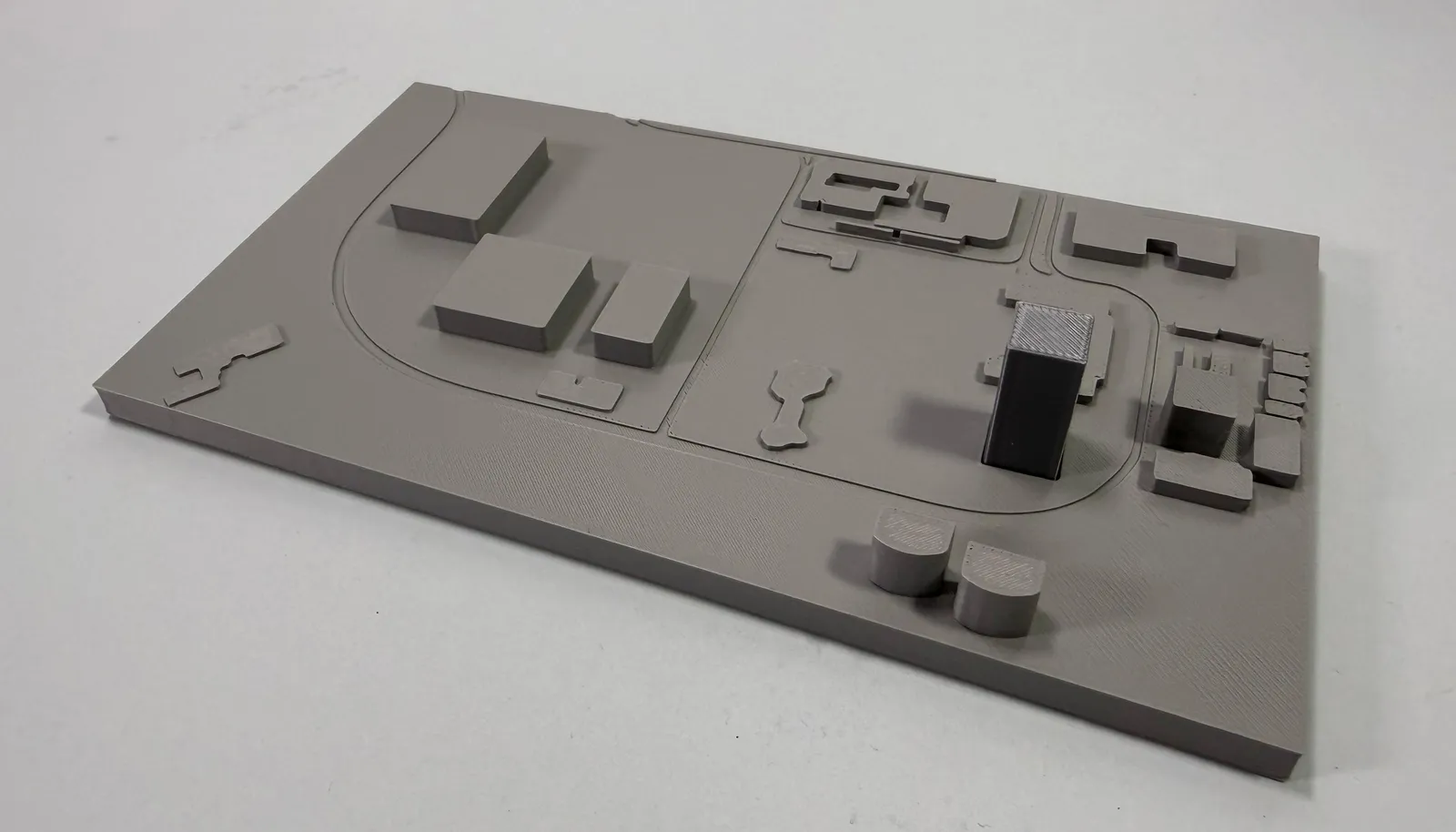
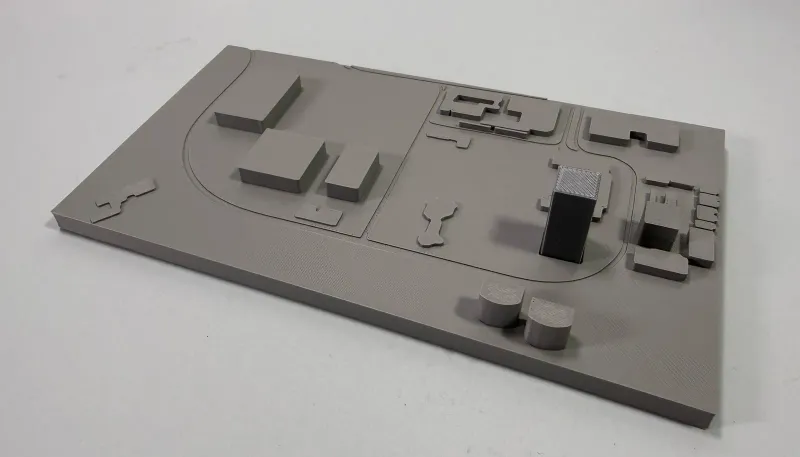
Our civic centre model shows that line. Every building stands at its number of floors, and the new tower lifts out of its socket. There is no traffic, planting or person, so we call it a site model. Add ground texture, vehicles, trees and figures, and the same base would read as a diorama.
Museum dioramas
The word comes from a theatre show by Louis Daguerre and Charles Marie Bouton, who used changing light to give a translucent painting the illusion of depth. One of the first museum uses was at the Biological Museum in Stockholm, which opened in 1893.
A museum diorama is often full size. It uses a tilted-plane effect to stand for level ground, and often paints the distant scenery on a curved surface so no corner shows. Objects are scaled to fake distance.
- That is a different craft from ours. We build scale models, lit and cased.
- We have no museum habitat on our site. Tell us the size and we will say whether it suits us.
Hobby dioramas: tanks, trains and figures
Hobbyists build dioramas around military vehicles, figures and aircraft. Their scales often run at 1:35 or 1:48, and HO model railways use 1:87. Tamiya lists 1/35 and 1/48 military miniature series, and the National Model Railroad Association (NMRA) gives HO as 1:87.1. A good 3D printed miniature can be the first piece of one.
An early and very large example is William Siborne’s Battle of Waterloo, built between 1830 and 1838. By Wikipedia’s account it measures 8.33 by 6 metres and used around 70,000 model soldiers. A desk scene has a handful.
Site and construction dioramas
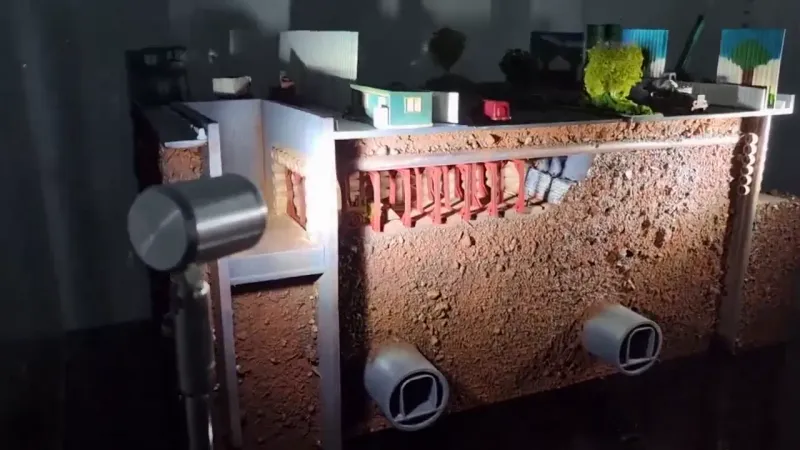
For LTA we made cutaway models of MRT construction at 1:200. A street and worksite sit on top. Below it the ground is cut open to show the strutted dig, a shaft and two tunnels.
The top carries a crane, an excavator, a cement mixer, hoarding and tiny workers. The soil was textured and painted by hand, layer by layer. Each model sits in a clear acrylic case with spotlights switched on from a button on the base.
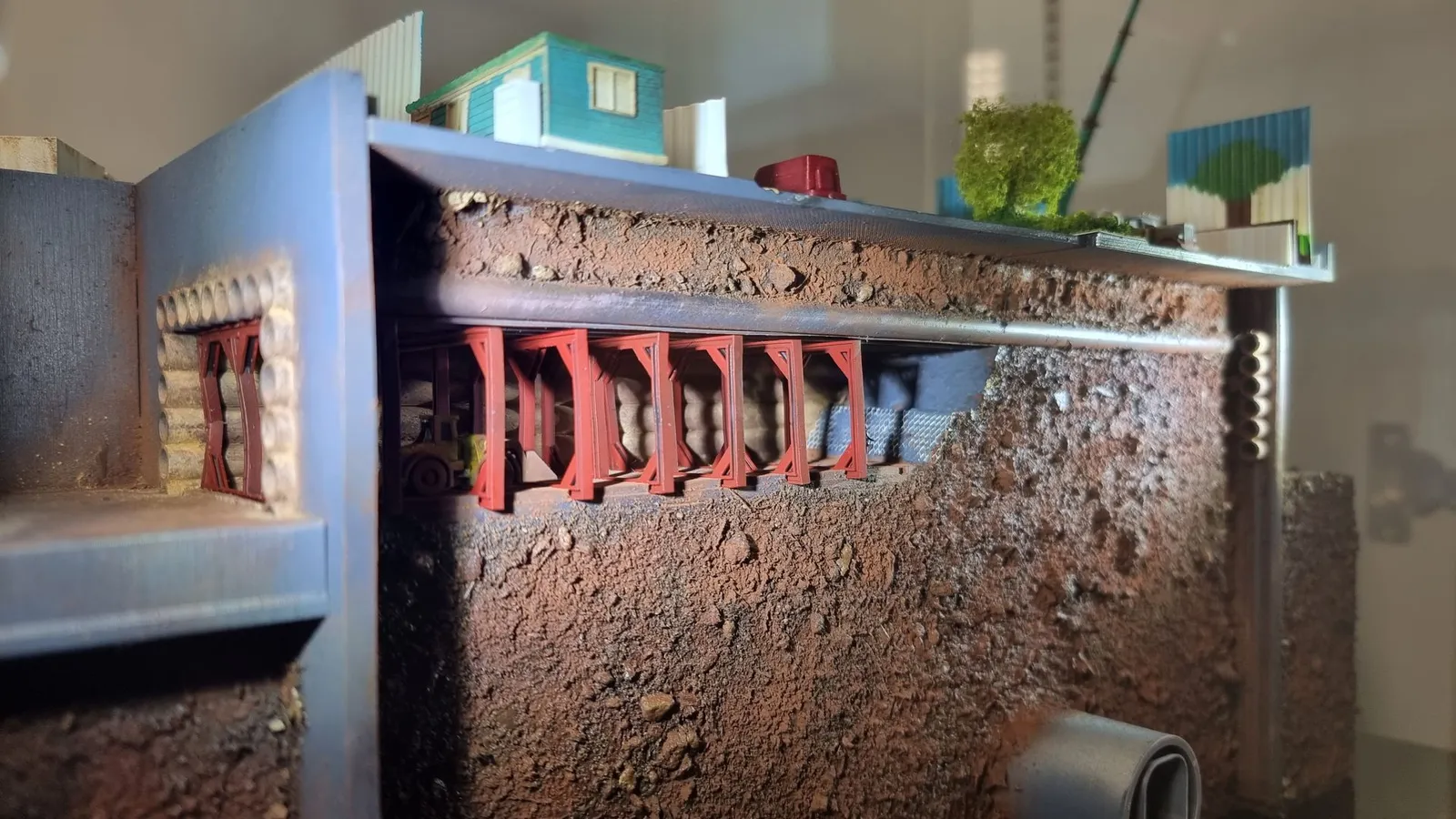
The limit is time. The three cases took 9 to 11 weeks of fabrication after the design was approved.
Trophy dioramas
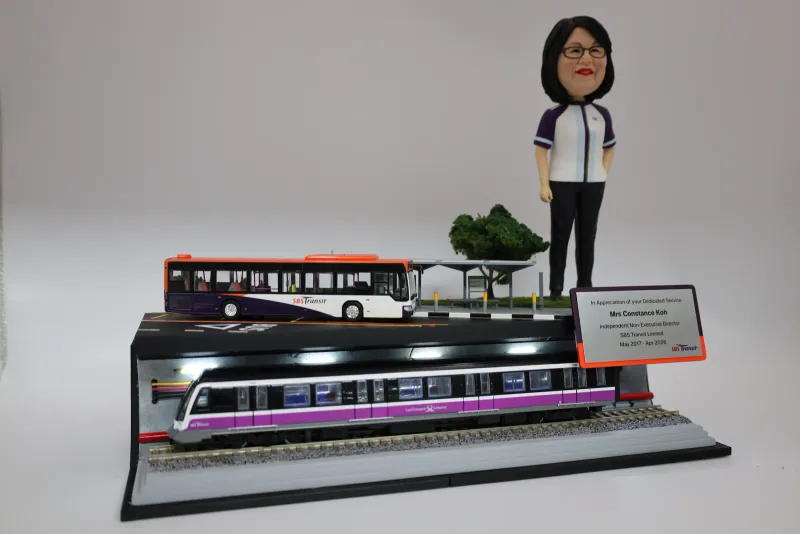
A diorama makes a trophy that is plainly about its owner. For SBS Transit we put a bus at its stop on a road deck, with an MRT train in a lit tunnel below. A caricature figurine of the recipient stands beside a name plate. All of it sits under a clear acrylic case.
The base is 357 by 160 mm as designed. Two rounds of 3D renders fixed the sizes, lights and plate wording before anything was built.

For the case itself, read how to choose an acrylic display case.
What goes into one
The same parts turn up in the dioramas we have built:
- The base and ground. For LTA the ground block was printed in plain white, then primed, then painted and textured by hand.
- The things on it. Struts, tanks, cabins and vehicles were printed in batches, and each small part was trimmed by hand.
- Scenery and people. Trees, hoarding, road markings and tiny figures, or flocked grass and model trees on the SBS base.
- Light. The wiring goes into the base, with a button or switch on the outside.
- The case. Clear acrylic over a deep base that holds the wiring, so the scene is seen from every side.
Both were modelled in 3D first, so the layout was agreed before anything was made. For the full workshop sequence, see how architectural scale models are made.
Which scale to pick
Pick the scale from two questions. How much ground must fit on the base? What is the smallest detail that must still show?
A scale is a ratio: 1:200 means 1 unit on the model stands for 200 in life. So at 1:200, a 40 m street is 200 mm across and a 1.7 m person is about 8.5 mm tall.
Detail is the other side. At 1:200, 1 mm on the model is 200 mm in life, so a handrail thinner than that has to be drawn thicker to print. Our rule from the architecture guide: the smallest feature that matters should be at least 1 mm thick at the chosen scale.
Architects’ models often use 1:50, 1:100, 1:200 or 1:500. A trophy has no standard scale, because the case sets the size.
How long it takes
Our scale models page says 2 to 12 weeks, and large or lit pieces take longer. The work runs in order: design approval, printing, hand painting, wiring. Tell us the date you need it by and a person confirms the timeline with the quote.
Where these facts come from
Facts about dioramas and scales were read on 19 November 2026. What Additive Inn makes is from our own project pages.
- Wikipedia, Diorama: the definition, the Daguerre and Bouton origin, the Stockholm museum, museum technique and the Siborne model (its size and soldier count are Wikipedia’s figures; other sources differ).
- Tamiya, 1/35 and 1/48 military miniature series: the hobby scales. NMRA, Standards for Proto Models (S-1.1): HO at 1:87.1.
- Wikipedia, Scale model: what a scale ratio means and the typical architectural scales.
- Our own pages: LTA MRT construction diorama, SBS Transit diorama trophy, civic centre site model and scale models.
Frequently asked
What is the difference between a diorama and a scale model?
A scale model is one thing built at a set ratio to the real one. A diorama is a replica of a scene: the thing, the ground it stands on and what is around it. Our civic centre model shows buildings at their real heights on a plain base, so it is a site model. The MRT worksite has traffic, machinery and workers, so it is a diorama.
What is the most common diorama scale?
There is no single answer. Hobby scenes often use 1:35 or 1:48, HO model railways use 1:87, and architects' models often use 1:100, 1:200 or 1:500. Pick by what must fit on the base and how small the smallest detail can be.
How big is a finished diorama?
The scale and the real size of the scene decide it. The SBS Transit trophy has a base of 357 by 160 mm as designed, which is compact for a trophy. The LTA cutaways at 1:200 each sit in their own lit acrylic case.
Can you make a diorama from photos or drawings?
Yes. Send drawings, a site plan, an aerial view or photos. Our civic centre model was built from an aerial view and two slides naming each building and its floors. A person checks what you send.
Do dioramas light up?
Ours can. The LTA cutaways have spotlights switched on with a button on the base, and the SBS trophy has lights along its tunnel wall with a switch and socket on the side. Say at the start if you want light, because the base has to hold the wiring.
Can a diorama be a trophy or a farewell gift?
Yes. The SBS Transit piece was made to thank a departing director. It puts a bus, a lit train and a caricature figurine of the recipient under one case, with a name plate in front.
Do you make museum habitat dioramas?
We have none on our site. Those are often full size with a painted curved backdrop. If you have a scene like that in mind, tell us the size and where it will stand, and we will say plainly whether we can do it.
How long does a diorama take?
Our scale models page gives 2 to 12 weeks, and large or lit pieces take longer. The three LTA cases took 9 to 11 weeks of fabrication after the design was approved. Ask us for a date for your own scene.
Related
-
 GuideHow is an architectural scale model actually made?
-
 GuideHow do you choose an acrylic display case for a model, figurine or award?
-
 GuideHow do you get 3D printed miniatures that paint well?
-
 ServiceIndustrial 3D Printing
-
 ServiceColour Application & Finishing
-
 Service3D Modelling, CAD and 3D Scanning
-
 ProjectMRT construction diorama for LTA
-
 ProjectDiorama trophy for SBS Transit
-
 ProjectCivic centre site model for a private client