How is a bespoke trophy actually made?
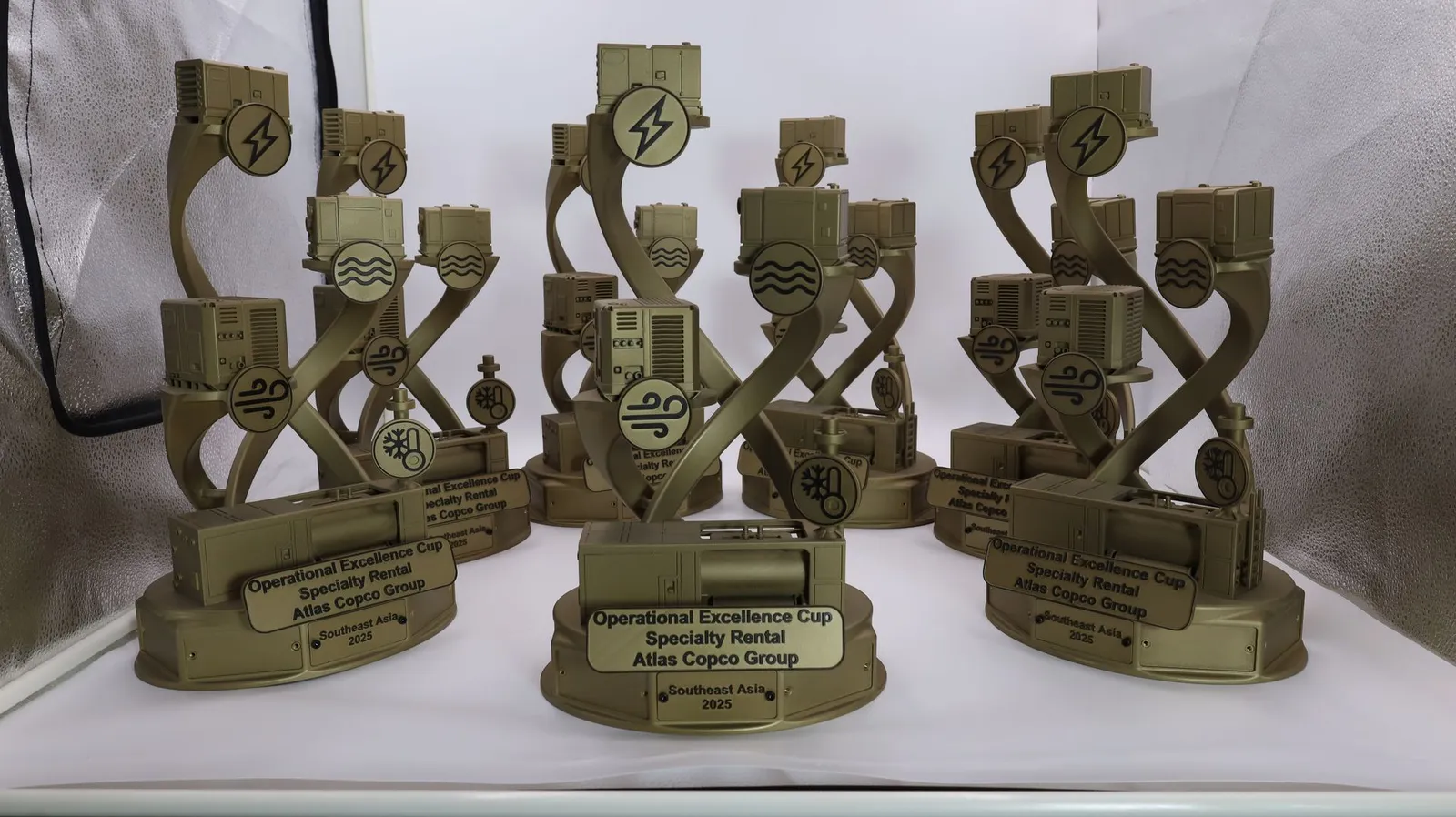
A bespoke trophy goes through six stages in our workshop: a brief and concept sketches, 3D design in CAD, a 3D-printed master, finishing by electroplating or paint, engraving and plaques, then the base, case and packing. A single piece typically takes 5 to 7 working days once the design is approved, longer for matched sets. We have built awards this way for SGX, GIC, BMW Group Asia, Crestron and the Singapore Armed Forces.
Where does the design start?
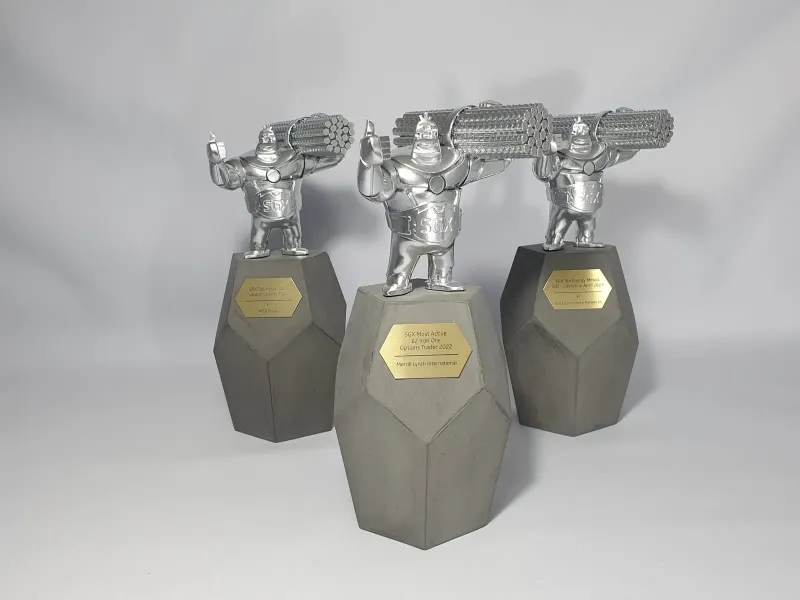
With whatever you have: a logo, a theme, a mascot, or just the occasion. Our custom trophy service sketches two to three directions and picks one with you. For the SGX mascot trophy we worked with the client until the figure, carrying a load of metal rods on its shoulders, stood for the resilience SGX wanted. The Spartan statue award for the last batch of 6 SIR came together the same way.

Rather explore on your own first? The Trophy Studio is our in-browser design chat: give it your budget and deadline, browse real past pieces, and preview a design.
What gets decided in computer-aided design (CAD)?
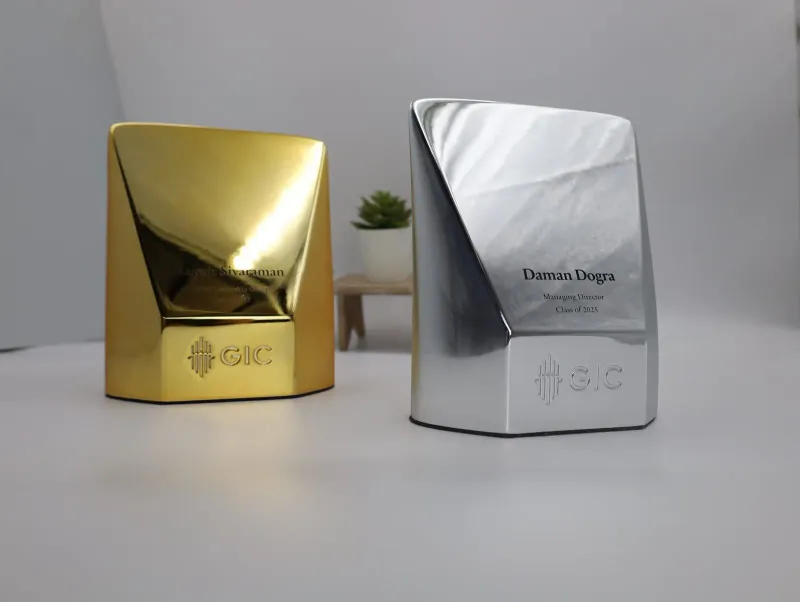
More than the shape. Engraving plate areas, mounting points and presentation packaging are designed in from the start. On the GIC awards, the logo was built into the model rather than applied afterwards.

Why is the master 3D printed?
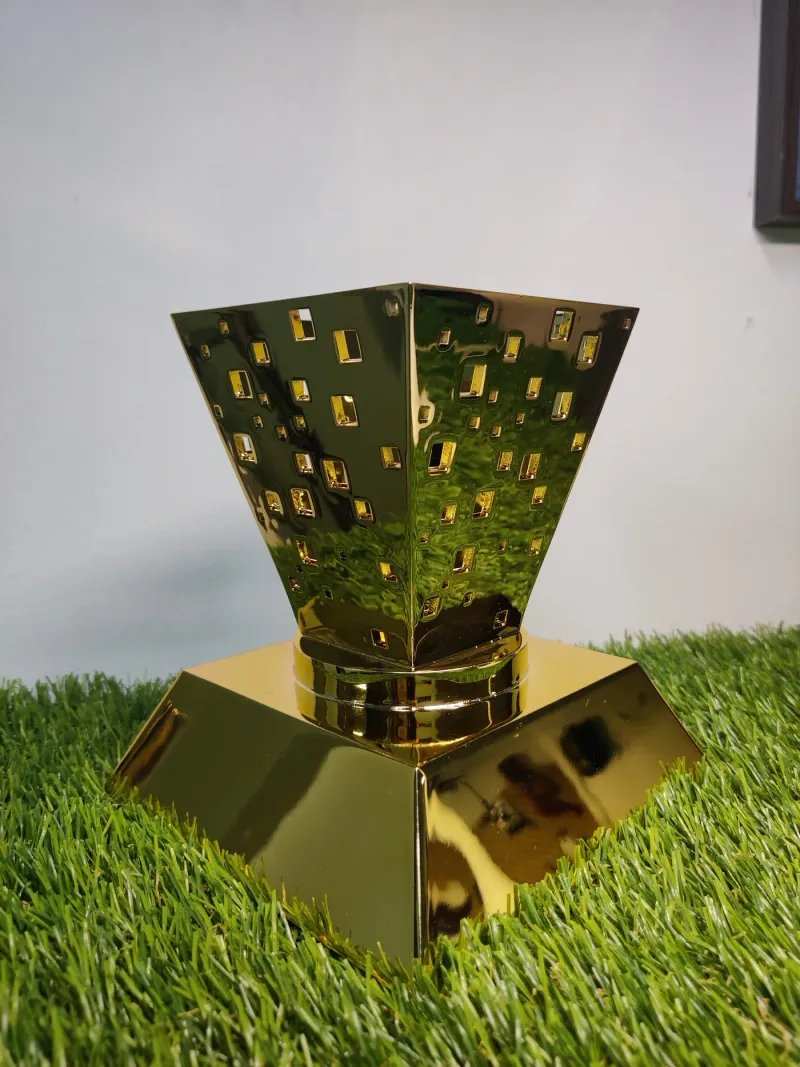
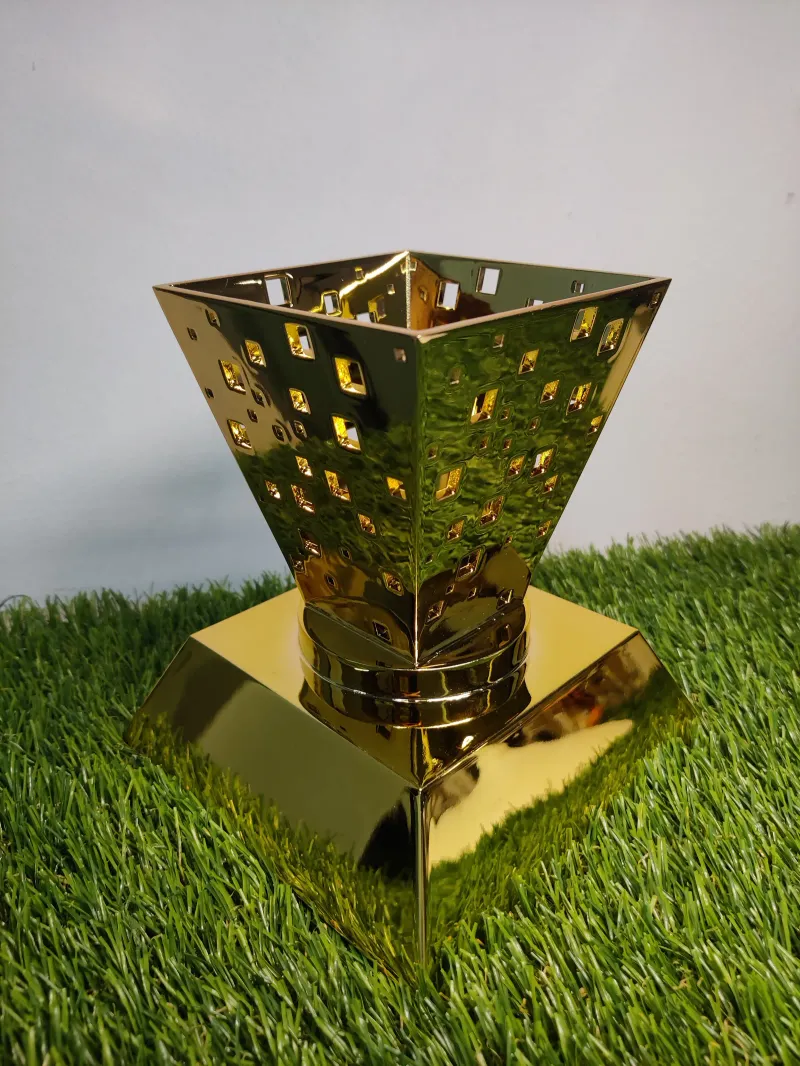
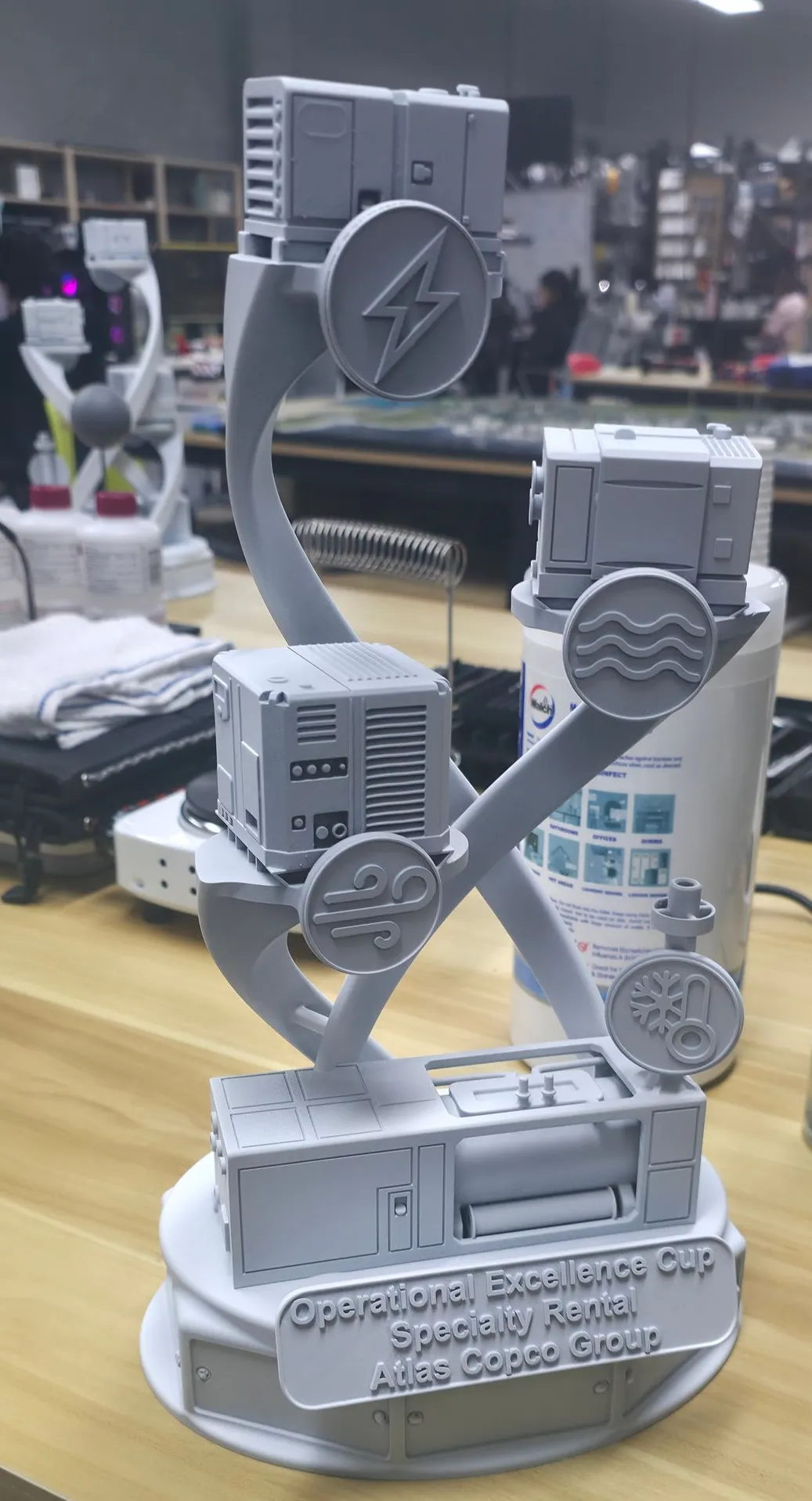
Because printing frees the form. A sculpted mascot, sharp tapers or a perforated shell would be costly or impossible to machine, but they print. We print masters in stereolithography (SLA) resin for fine detail or fused deposition modeling (FDM) for scale. The square perforations on our electroplated trophy were printed to tight tolerances so every face matched, and the GIC bodies were printed at high resolution, then reinforced inside.

Sometimes the printed part is not the star. For the Crestron camera trophy a real Crestron PTZ camera is the award; we printed the base in stiff carbon-fibre-filled PETG-CF and re-wired the camera’s LED strip so it stays lit on the shelf.
How does a printed part end up looking like cast metal?
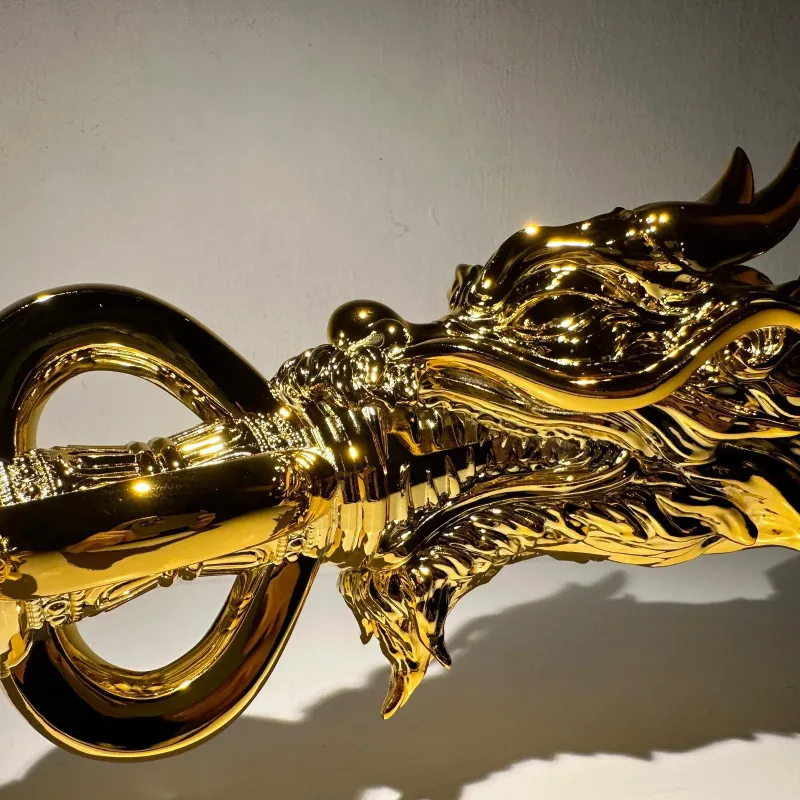
Preparation, then plating. Each part is sanded, primed and smoothed in stages, because plating magnifies every defect. Then it is electroplated in real chrome, gold, copper or brass: a metal skin 50 to 200 microns thick, with the weight and shine to match. Plating is priced by surface area; our electroplating guide covers the finishes.


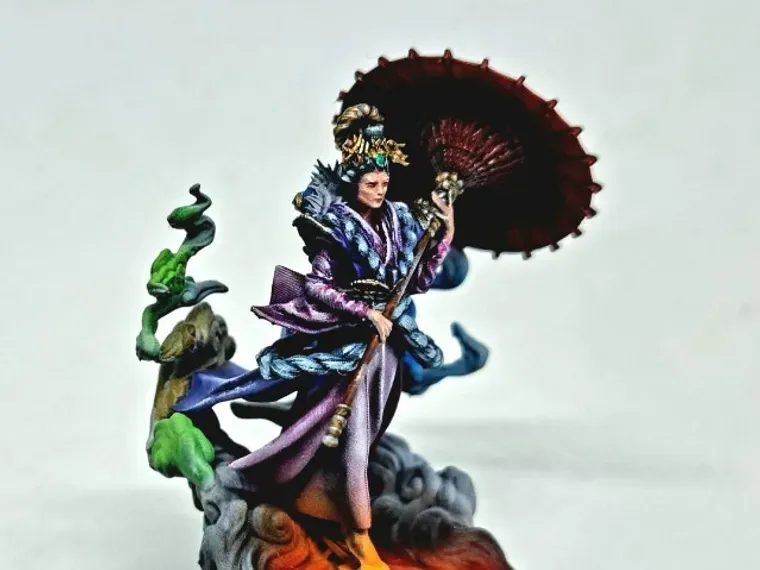
Not every award wants to be metal. The BMW MINI Retail Next trophy pairs a printed emblem in metallic silver with clear and green-tinted acrylic, and airbrushed paint over primer handles gradients and brand colours. All of it happens on our in-house finishing bench.
What about engraving, bases and presentation?
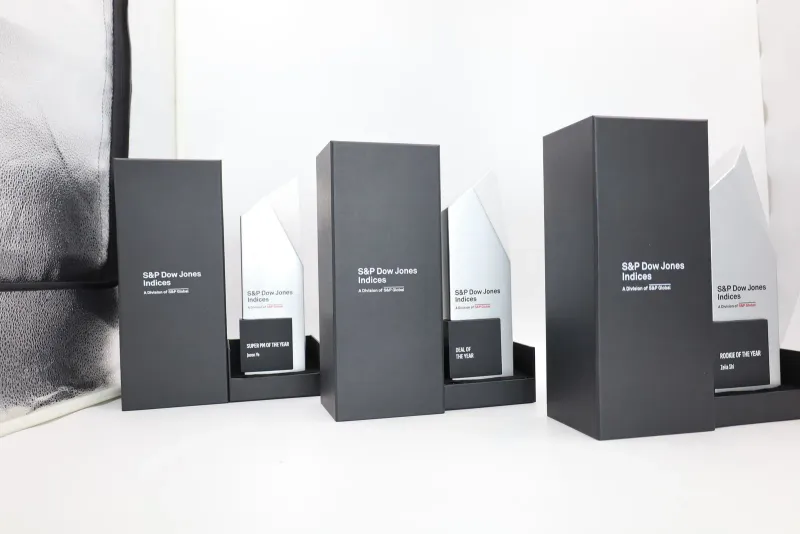
This is the part the recipient touches first. Plaques are engraved per recipient. The Crestron base has a recessed slot its etched metal plate drops into, and the whole piece sits under a clear acrylic case. Presentation cases are designed alongside the trophy, so it is ready to hand over on the day.


How long does it take, and what does it cost?
A single painted or electroplated piece takes 12 to 18 working days in all, print included. A run of 20 to 50 with electroplating takes at least 18 working days, often longer, so ask us for a date, and a volume run with bespoke presentation cases is 4 to 6 weeks. We have turned trophies in 48 hours when the alternative was no trophy at all, so tell us the deadline up front.
Every piece is quoted per design. For matched sets we cast from a silicone mould, priced once and then each cast per piece, or print in batches, with volume discounts from 10 units, listed in our pricing guide. Our awards landing page shows the spread.
Start a design in the Trophy Studio, or send your logo, theme and quantity through our contact page and we will propose a concept and a price, usually the same business day.
Frequently asked
What is the master in custom trophy making?
The master is the 3D-printed original that carries the trophy's form, printed in SLA resin for fine detail or FDM for larger pieces. Everything that follows, the sanding, electroplating or paint, engraving and assembly, builds on that one part. For matched sets the master is also what the silicone mould is cast from, so every copy inherits the same detail.
Is an electroplated trophy made of real metal?
The skin is. Electroplating deposits an actual layer of chrome, gold, copper or brass, 50 to 200 microns thick, over the printed master, so the piece has the weight and reflectivity of cast metal. It is priced by the part's surface area, and the starting prices are on our pricing page.
Can one trophy design be produced as a matched set?
Yes. For runs of roughly 20 to 500 we cast from a silicone mould (priced once, then each cast per piece), or print in batches, and volume discounts start at 10 units; our pricing guide lists the current rates. Plaques are engraved per recipient so the set stays personal.
How quickly can a bespoke trophy be ready?
A single painted or electroplated piece takes 12 to 18 working days in all, print included, a run of 20 to 50 with electroplating takes at least 18 working days, often longer, so ask us for a date, and volume runs with bespoke presentation cases run 4 to 6 weeks. With a hard ceremony date we can compress that; we have turned trophies around in 48 hours before. Finished pieces are self-collected at Bendemeer or couriered islandwide.
Related