ST Engineering Robot Casing
- ServiceProduct Development & Prototyping
- MaterialsPLA, Acrylic
- FinishesMatte black, Printed livery
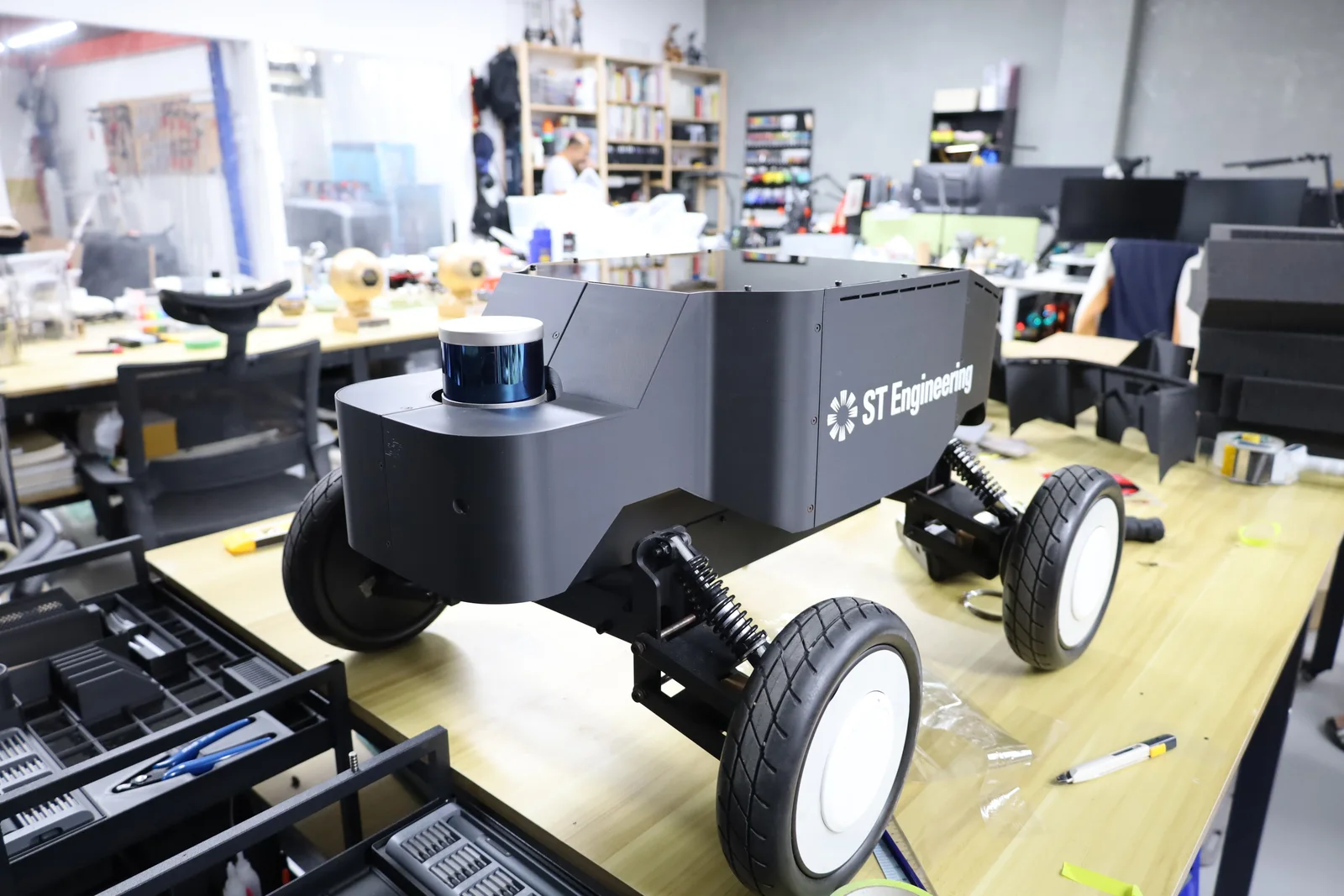
ST Engineering came to us with a newly developed autonomous robot and needed a body for it. We designed and built the casing: the faceted black shell that wraps the chassis, houses the electronics and gives the machine its finished look, printed to fit around the LiDAR, cameras, wheels and suspension it had to clear.
Designed to fit a working machine
A casing like this has to do more than look right. It has to clear the suspension through its full travel, leave the LiDAR and cameras an unobstructed view, sit off the hot and moving parts, and still come apart for access. We modelled the panels around the robot’s real hardware so every sensor, port and fastener lines up, added vents along the top for airflow, and split the shell into sections that lift off for servicing.
A heat-bent acrylic top
The top cover is a single sheet of acrylic, heat-bent to a smooth curve that follows the line of the body. It gives the robot a clean, continuous crown that a flat printed panel could not, and the gloss of the acrylic plays off the matte panels below. Bending it to the right radius without marking or stressing the sheet is its own small craft, and it is what makes the top read as one flowing surface.
Printed big, finished sharp
The shell panels are printed by fused deposition modeling (FDM) in PLA, sized and faceted so a large body could be built in sections and bolted up true. We finished them in a deep matte black and applied the ST Engineering livery, so what began as a set of printed parts reads as one purposeful, production-looking machine. It is the kind of job that sits right at the centre of what we do: take a working prototype and give it a body that looks ready for the field.