

Polaroid photo frame for JCDecaux, designed and prototyped
A desk photo frame for JCDecaux, shaped like its MUPI advertising panel, that holds a Polaroid and a message card. We designed it over two revisions and made a prototype.
- Client
- JCDecaux
- Also used
- Laser cutting & stickers
- What it is
- A desk photo frame shaped like a JCDecaux advertising panel
- What we did
- 3D design for manufacture, two revisions, test prints and a prototype
- What the client got
- The 3D files and an assembled prototype
- Design revisions, from three slots to two
- 2
- Tall in Revision 1, 59 mm wide and 15 mm deep
- 95.5 mm
- Test blocks printed to choose the depth, 10 to 17.5 mm
- 4
What we brought
What we can do
Their own panel, in miniature
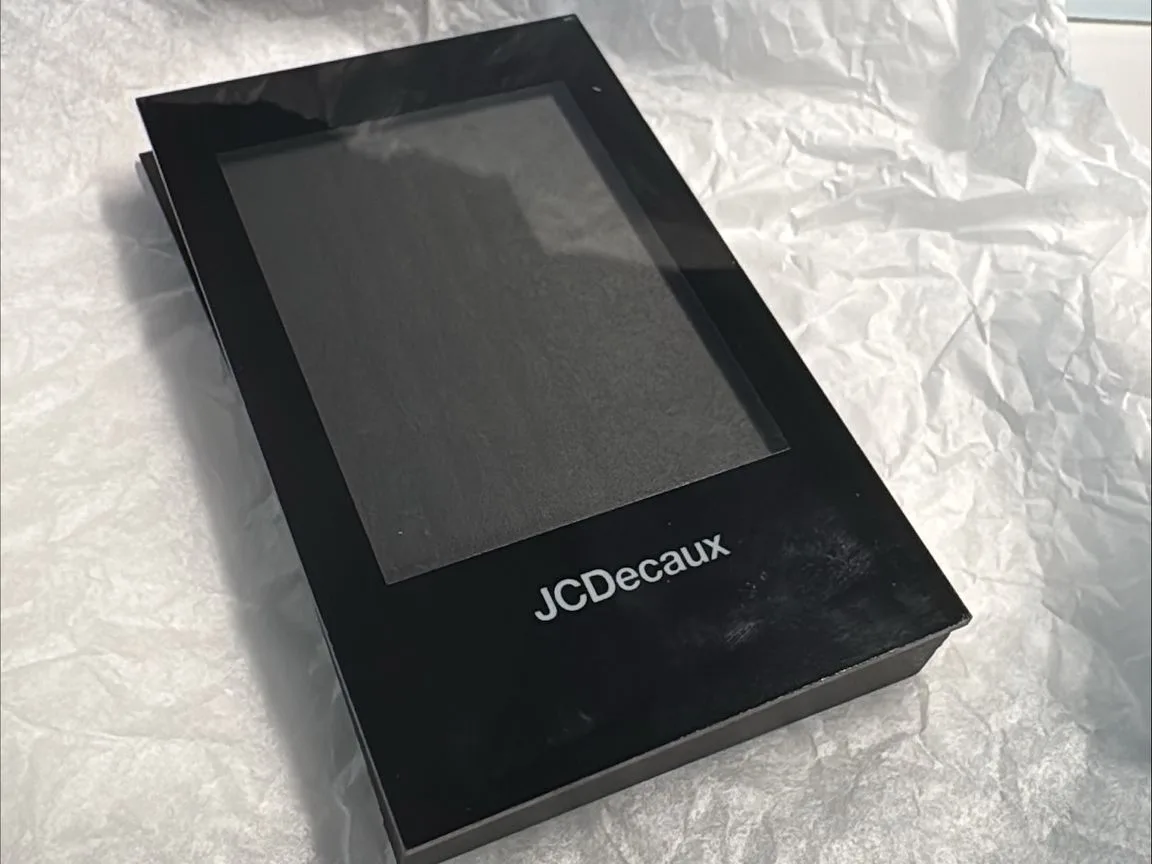
The frame takes the look of a JCDecaux advertising panel: black, with a window for the picture and the logo under it, at a size that sits on a desk.
How we look after you
Felt before it was chosen
We printed test blocks at four depths so the client could hold each one and judge the weight before we made the prototype.
What you get
Designed around what it holds
Two 1.2 mm slots take a Polaroid and a message card, and a latch at the base opens so they can be taken out.
Gallery
The whole project at a glance. Drag or swipe to browse; tap a picture to enlarge it.
1 / 6
-
The finished piece
-
A keychain firstRenderA black D-ring, keeping the frame 15 mm deep.
-
RenderA gold ring, 16 mm deep.
-
Two revisions of the desk frame · Revision 0RenderThe hinge that lets the lid swing open.
-
Two revisions of the desk frame · Revision 1DrawingTwo slots, 1.2 mm each.
-
Test blocks and partsFour depths to hold and compare.
The build
How we built it
6 steps, from the brief to the finished piece. Pick a step to jump to it.
The brief
Step 1 of 6 · 03/03/2026
- Holds
- A Polaroid photo and a message card
- First size
- 117 by 66 by 15 mm, with a hook on top
- Our scope
- 3D design for manufacture, revisions and one prototype
At Additive Inn, our 3D printing studio in Singapore, we designed and prototyped a small photo frame for JCDecaux. It is a miniature of the MUPI, JCDecaux's advertising panel, made to hold a Polaroid photo and a message card.
The first brief was a keychain: 117 mm tall, 66 mm wide and 15 mm deep, with black acrylic faces around a 3D printed core.
A keychain first
Step 2 of 6 · 05/03/2026
We started with the hook. Our renders showed two ways to set a ring into the top edge: a slim D-ring that kept the frame 15 mm deep, or a gold ring that took it to 16 mm.
An early printed mock-up then went to the client's office. They asked for something smaller and heavier, so it would feel more premium, and the keychain became a frame that stands on a desk.
Two revisions of the desk frame
Step 3 of 6
We drew the desk frame in two revisions, each sent with its renders and measurements. The window stayed 60 by 45 mm in both.
-
Revision 0 · 20/03/2026
96.6 mm tall, 67 mm wide and 13.5 mm deep, with three slots. Gloss black acrylic faces and clear acrylic windows sit around a matte printed core, and a magnetic lid at the base swings open on a small hinge.
Render
-
Revision 1 · 25/03/2026
Shorter at 95.5 mm, as short as it can go and still house the magnet, and narrower at 59 mm. Two 1.2 mm slots in place of three, and 15 mm deep, the depth of the first mock-up, which stood on its own.
Drawing
Test blocks and parts
Step 4 of 6 · 26/03/2026
Before making the prototype, we printed four test blocks, 10, 12.5, 15 and 17.5 mm thick, so the client could feel the weight and see how each one stands. The client left the choice of depth to us.
We then printed the core and the latch in matte black, and laser cut the acrylic faces and windows. The JCDecaux logo was laser engraved on the front.
Putting it together
Step 5 of 6 · 06/04/2026
The clear acrylic sits behind the black front frame, as in the design. The printed core carries the slots for the photo and the card, and the latch at its base closes the frame, held shut by a magnet.
The final build
Step 6 of 6 · 07/04/2026
JCDecaux collected the assembled prototype from our studio, along with the 3D files of the design. The frame holds a Polaroid and a message card behind a clear window, with the JCDecaux logo on the front.
More product development
See all product development →-
 CMP Technologies Scuba gear display stands for CMP Technologies Slatwall displays made to fit CMP Technologies' regulators, masks and fins: bent steel stands with 3D printed holders, in place of off-the-shelf hooks.
-
 Rezilienz 3D printed revolver mic stand A prop revolver for Rezilienz that holds a wireless microphone in its cylinder, with a chrome-plated frame and a textured grip.
-
 XCam Lite camera housings for SnapX Housings for SnapX's XCam Lite timelapse cameras: a branded, 3D printed front with a slide-out lens window, then a sealed weatherproof box.