

What is vacuum forming, and when should you use it?
On this page
- Vacuum forming at a glance: thin shells from one mould
- How vacuum forming works: heat, pull down, trim
- What vacuum forming is good for: many identical thin shells
- Sheet plastics: pick clear, low-cost or tough
- Design rules: taper the walls and keep it shallow
- 3D printing the mould: quick to make and to change
- When to use something else: four better routes
- Frequently asked
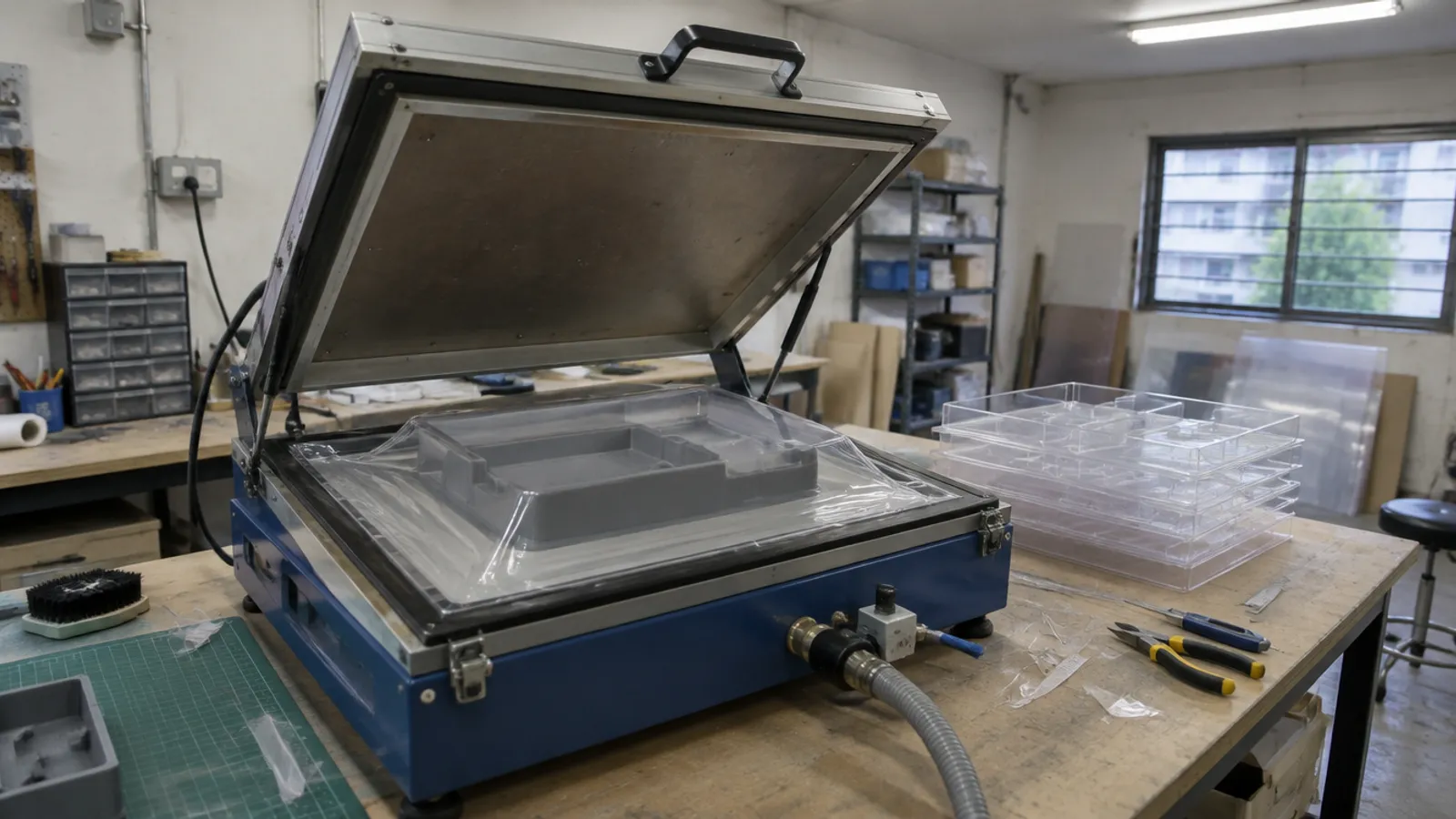
Vacuum forming heats a plastic sheet until it is soft, then sucks it down over a mould so it cools in the mould’s shape. It makes thin shells that are open on one side, such as trays, covers, packaging inserts and sign faces, and it pays off when you need many of the same shape. We take vacuum forming jobs in Singapore and can 3D print the mould from your file, which is where it meets 3D printing.
Vacuum forming at a glance: thin shells from one mould
| What you want to know | Vacuum forming |
|---|---|
| What it does | Heats a plastic sheet and pulls it onto a mould by suction |
| What it makes | Thin shells open on one side: trays, covers, inserts, sign faces |
| Common sheet plastics | PETG, HIPS, ABS, acrylic and polycarbonate |
| Largest part | Set by the machine and the sheet: tell us the size and we confirm |
| Detail and accuracy | Only the face that touches the mould is exact; the other face is softer |
| Mould | One mould per shape, which we can 3D print from your file |
| Lead time, normal-size part | Depends mostly on the mould, so check with us |
| Best for | Many identical shells, clear covers, packaging and display trays |
| Not for | Solid parts, overhangs that lock onto the mould, or one or two pieces |
How vacuum forming works: heat, pull down, trim
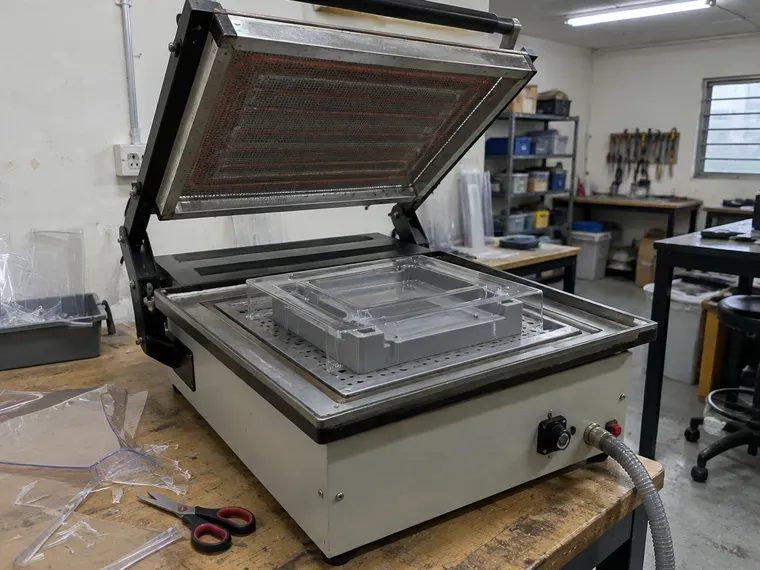
Vacuum forming is the simplest kind of thermoforming, the family name for shaping a heated plastic sheet over a mould (Formech, a maker of vacuum forming machines). It runs in four steps:
- Heat. A flat sheet is clamped in a frame and heated until it sags and goes soft.
- Form. The mould rises into the soft sheet and a vacuum sucks out the air underneath, pulling the plastic tight against the mould.
- Cool. The plastic cools and keeps the shape, then lifts off the mould.
- Trim. The flat edge around the part is cut away, leaving the finished shell.
Because the sheet is only pulled by suction, the pressure is low. That is why a mould can be printed, cast or carved instead of cut from steel.
What vacuum forming is good for: many identical thin shells
- Packaging: trays, blister packs and inserts that hold a product in place. Formlabs calls vacuum forming one of the most common ways to make packaging (Formlabs).
- Covers and guards: clear covers over a display or a machine, domes and light covers.
- Sign faces and displays: a shaped face for a lightbox, often in clear PETG or acrylic printed on the back so the print shows through.
- Light shells: casings, props and panels where only the outside has to look right.
The mould costs far less than an injection moulding tool, so prototypes and short to medium runs of large parts become good value (Formech). The limit is the shape: one even sheet, open on one side, never a solid part.
Sheet plastics: pick clear, low-cost or tough
Each plastic forms differently. This table follows Formech’s guide to popular vacuum forming materials.
| Plastic | Known for | Used for |
|---|---|---|
| PETG | Clear and easy to form | Clear covers and sign faces |
| HIPS | Low cost and easy to form | Display stands and packaging |
| ABS | Tough and takes knocks | Enclosures and outdoor parts |
| Acrylic | Very clear and weathers well, but brittle | Displays, signs and windows |
| Polycarbonate | Very tough, but hard to keep crystal clear | Machine guards and skylights |
ABS, acrylic and polycarbonate soak up moisture from the air, so the sheet is baked dry before forming; PETG and HIPS are not. HIPS is high-impact polystyrene, and acrylic is also sold as PMMA. Cast acrylic only forms gentle, shallow shapes. Tell us whether the part must be clear, live outdoors or take knocks, and we suggest the sheet.
Design rules: taper the walls and keep it shallow
These five rules decide whether a shape forms cleanly. We check your file against them before the mould is made.
- Raised or hollow mould. A male mould is a raised shape the sheet drapes over; a female mould is a hollow the sheet is pulled into. Male moulds usually cost less, and a female mould puts sharp detail on the outside of the part (Formech on male and female moulds).
- Only one face is exact. The face against the mould takes its exact shape. The other face sits a sheet’s thickness away, so its edges and detail come out softer. Decide which face people will see, and that sets the mould.
- Draft. Walls need a slight taper so the part lifts off: about 4 to 5° on a male mould and 1.5 to 3° on a female one, more for deep or textured shapes (Formlabs).
- Depth. The sheet stretches to reach the bottom, so deep shapes come out thinner. Syracuse University’s workshop guide keeps a hollow’s depth under about 75% of its width, or the sheet may tear.
- Webbing and overhangs. Raised shapes set close together can pull the sheet into folds called webbing. Rounded corners, wider spacing or a female mould prevent it (Formech on webbing). Avoid overhangs (undercuts), which lock the part onto the mould.
3D printing the mould: quick to make and to change
The mould, also called a buck or a tool, used to be machined or cast, which takes time and money. A 3D printed mould saves both, and text or texture on it costs nothing extra (Formlabs).
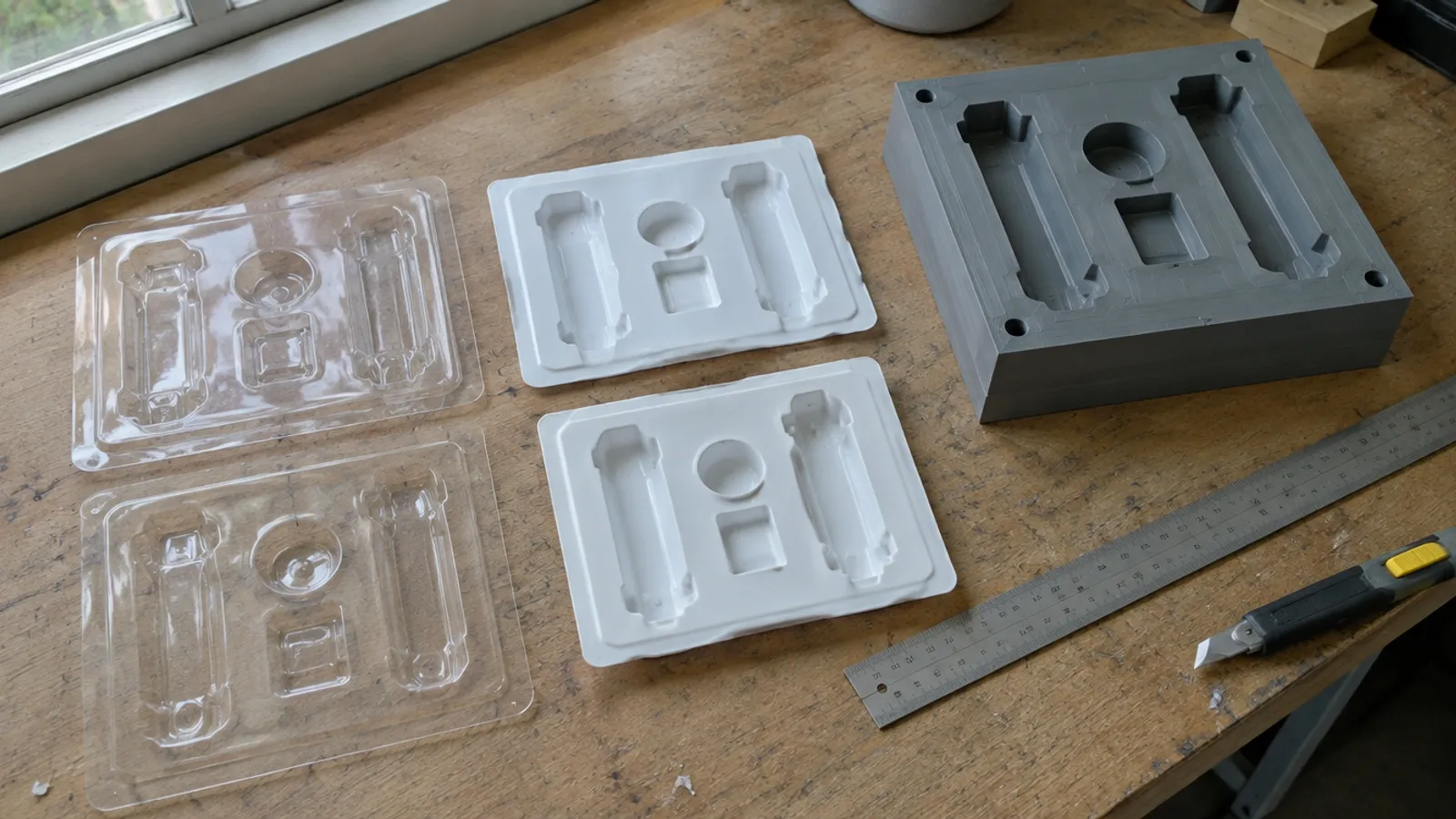
We print the mould from your 3D file. Five things are worth knowing about it:
- Changes are quick. Change the file and reprint the mould, with no tool to re-cut.
- It must take the heat. A hot sheet lands on it every cycle, and a poorly chosen print material can deform, crack or even melt (Formech), so we print it in one that holds its shape.
- It is smoothed first. The vacuum pulls the sheet into fine detail, tool marks included (Syracuse University), so layer lines are sanded off before forming.
- Vent holes are built in. Small holes let the vacuum reach every pocket; without them the sheet drapes over a pocket instead of following it (Formlabs).
- It suits a run, not years of production. Formlabs reports printed moulds lasting for dozens of parts with care. Tell us your quantity and we say whether a printed mould suits it.
No 3D file? Our design team can model the part from a sketch, a photo or a sample.
When to use something else: four better routes
| Your part | A better route than vacuum forming |
|---|---|
| One or two pieces, any shape | 3D print the part itself: no mould needed |
| Solid, thick, or detailed on every face | Silicone moulding, also called vacuum casting |
| Flat and clear | Laser-cut acrylic |
| Thousands of solid parts | Injection moulding |

Despite the name, vacuum casting is a different process: liquid resin is poured into a silicone mould under vacuum to make solid parts. For how printing, casting and injection moulding compare by quantity, see 3D printing vs silicone vs injection moulding. For a clear part with a true 3D shape, see how clear a 3D printed part can get.
Frequently asked
Is vacuum forming the same as thermoforming?
Vacuum forming is one kind of thermoforming, the family of processes that shape a heated plastic sheet over a mould. In vacuum forming, suction alone pulls the soft sheet onto the mould, which keeps the moulds simple and low cost.
What is the difference between vacuum forming and vacuum casting?
Vacuum forming shapes a heated plastic sheet into a thin shell, while vacuum casting pours liquid resin into a silicone mould under vacuum to make solid parts. Pick forming for trays, covers and sign faces, and casting for solid parts with detail on every side, such as housings, knobs and rubber-like pieces.
What plastics can be vacuum formed?
The common plastics for vacuum forming are PETG, HIPS, ABS, acrylic and polycarbonate sheet. PETG and acrylic suit clear parts, HIPS suits low-cost packaging and displays, ABS suits tough enclosures, and polycarbonate suits guards that take knocks. ABS, acrylic and polycarbonate soak up moisture from the air, so they are dried before forming.
Can you vacuum form over a 3D printed mould?
Yes, a 3D printed mould works for vacuum forming, and it is how we usually make a new one: we 3D print it from your file, smooth it, and add vent holes so the vacuum reaches every pocket. The printed mould must be in a material that stands the hot sheet, and it suits a run of parts rather than years of production. Changing the design means reprinting the mould, not re-cutting a tool.
How deep can a vacuum formed part be?
How deep a vacuum formed part can be depends on the shape and the sheet, because the plastic stretches thinner the deeper it goes. One university workshop guide keeps a hollow mould's depth under about 75% of its width, or the sheet can tear. Tell us the part's size and depth and we confirm whether it forms in one piece.
What draft angle does a vacuum forming mould need?
A vacuum forming mould needs a draft angle of about 4 to 5° on a raised (male) mould and 1.5 to 3° on a hollow (female) mould, according to Formlabs' vacuum forming guide. Deep or textured shapes need more. Without that slight taper the cooled plastic grips the mould and is hard to lift off.
Is vacuum forming cheaper than injection moulding?
Vacuum forming is far cheaper to start than injection moulding, because it works at low pressure and its mould can be printed, cast or carved instead of cut from steel. That makes it good value for prototypes and short to medium runs of large, thin parts. It only makes shells, though, so a solid part with detail on every side still needs casting or injection moulding.
How big can you vacuum form, and how long does it take?
The largest vacuum formed part and the lead time both depend on the job. The largest size is set by the machine and the sheet, and the time mostly by how long the mould takes to make. Tell us the part's size and quantity and we confirm both.
Related
-
 GuideHow clear can a 3D printed part get?
 -
 GuideOne part, 50 or 5,000: 3D printing, silicone moulding or injection moulding?
 -
 GuideWhat is additive manufacturing, and how is it used?
 -
 ServiceVacuum Forming in Singapore
 -
 ServiceIndustrial 3D Printing
 -
 ServiceSilicone Molding & Vacuum Casting
 -
 ProjectTransparent Embossed Dome
 -
 ProjectLeaf Casting Mould
 -
 Project3D Printed Golf Ball Wind Tunnel