
How do you choose fringe activities for a corporate event in Singapore?
On this page
Fringe activities are the stations that run alongside the main programme at a corporate event: the photo booth, the caricature artist, the candy floss cart, the games corner. They give guests something to do between speeches, and they’re often what people talk about on Monday. The way to choose them is to work out how many people each one can serve, what space and power it needs, and whether guests leave with something, then match that to your event.
Fringe activities at a glance
| Activity | Rough guests an hour, one station | Space and power | Guests take home |
|---|---|---|---|
| Photo booth (prints) | 30 to 60 groups | Booth footprint plus a backdrop, 1 power point | A printed photo |
| AI photo booth | 20 to 40 groups | A table and a screen, 1 power point | A printed or sent image |
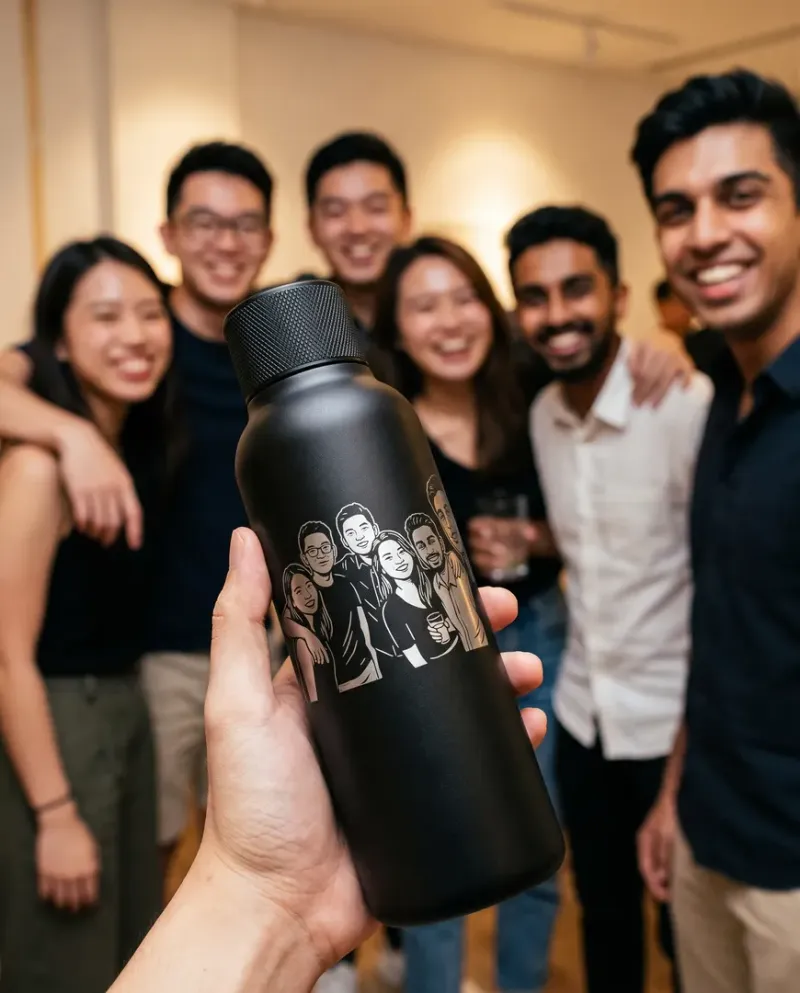
| Live engraving | Per piece: we plan it to your headcount | A table about 1.8 m, 1 power point | An engraved bottle, keychain or tag |
| Live embroidery | 6 to 12 pieces | A table and a machine, 1 power point | An embroidered cap, tote or patch |
| Tote or tee printing | 20 to 40 pieces | A table and a heat press, 1 power point | A printed tote or tee |
| Carnival games | 60 or more plays | A stall each, no power for most | Prizes, if you buy them |
| Face painting | 10 to 20 kids | A table and two chairs, no power | Nothing to carry: it’s the face |
| Caricature artist | 12 to 20 faces | A chair and an easel, or roving | A drawing on paper |
| Balloon sculptor | 20 to 40 balloons | Roving, no power | A balloon |
| Food cart (popcorn, candy floss, ice cream) | 60 or more servings | A cart, 1 power point for most | Something to eat |
These are rough figures for one station with one operator. A vendor’s own number for your event beats this table.
How to choose fringe activities
Start with your crowd, not the menu. Five questions settle most line-ups.
How many guests, and over how long? Assume about half your guests try any one popular activity. Take 300 guests and a three-hour window: that’s 150 people, or 50 an hour. A caricature artist drawing 15 faces an hour covers a third of that, so either book two or accept that some guests miss out. A photo booth or a food cart keeps up easily.
How much space and power is there? Each station needs its footprint plus room for a short queue, so plan on roughly a 3 m by 3 m patch. Anything with a printer, a screen, a laser or a heat press needs a power point. Ask the venue how many sockets are free and where. Running cables across a walkway is usually off the table.
Indoors or outdoors? A ballroom D&D (dinner and dance) has air-conditioning and steady power. A family day at a park or a chalet has heat, sun and the afternoon thunderstorm. Anything electronic needs a tent or a covered spot, and face paint and chocolate don’t love 33°C either.
Experience or take-home? A game or a magician is over when it’s over. A take-home, like a printed photo, a caricature or an engraved bottle, keeps working after the event. Take-homes cost more per guest and take longer per guest, so they’re worth it when the thing is something people will actually keep. Our door gift guide covers what survives the drawer.
Does it fit the brand and the room? A product launch wants activities that show off the product or the logo. A family day wants things kids can do. A conference wants something quick that people can do between sessions without missing a talk.
On budget: vendors price fringe activities in three ways. By the hour (entertainers, most photo booths), by the piece (customisation, some food carts) or as a package. A per-piece activity scales with how many guests take part, so decide up front whether you’re capping the number or covering everyone who asks.
Which activities suit which event
- D&D (dinner and dance). Guests are dressed up and seated for most of the night, so the window is short: arrival drinks and after dinner. A photo booth earns its place here. Roving entertainers like a magician or a caricature artist work the tables without anyone leaving their seat.
- Family day. The longest window and the widest age range. Mix one thing for kids (face painting, crafts, balloons) with one thing families do together (games, a photo booth, a take-home with the family’s own photo on it). Food carts keep everyone around.
- Product launch. Fewer guests, more press and partners. One activity that carries the brand beats five that don’t: a live customisation station that puts your logo on something, or a photo booth framed with the product.
- Conference. People drop in during short breaks. Pick something that takes a couple of minutes, can be done alone, and doesn’t need guests to come back later. A take-home with a ticket system works if the collection point is on the way to the next session.
Photo booths and AI booths
A photo booth is still the most reliable fringe activity there is. Guests pose in groups, the booth prints the photo on the spot and often sends a digital copy. It handles a big crowd because each session takes a minute or so.
An AI booth takes a guest’s photo and restyles it, as a cartoon, a painting or a superhero, then prints it or sends it to their phone.
- Best for: D&Ds, launches and any event with a dress code or a theme.
- Watch for: prints get left on tables. A photo frame or a sleeve helps it survive the night.
- AI results vary. A restyled face doesn’t always look like the person, so ask the vendor to run a few test photos of your own team first.
- Guests’ photos are personal data. Ask any vendor that handles them where they’re stored and when they’re deleted, because Singapore’s Personal Data Protection Act (PDPA) applies.
Live customisation: engraving, embroidery and printing
Live customisation means guests watch something being made for them and walk away with it. It’s the strongest take-home in this list because it carries their name, their face or their team, not just your logo.
The common kinds:
- Live embroidery. A name or initials stitched onto a cap, tote or patch. It looks premium but it’s slow, often several minutes a piece.
- Tote or tee printing. Guests pick a design and it’s heat-pressed onto a tote or a tee in a couple of minutes. Fast, and good for a family day. Sizing tees for a mixed crowd is the hard part.
- Live engraving. A laser marks a design into metal or acrylic. The mark is cut into the surface, so it doesn’t peel or wash off.
All three share the same limit: one machine makes one piece at a time. Work out your headcount against the time per piece before you book, not on the day.
A live engraving booth
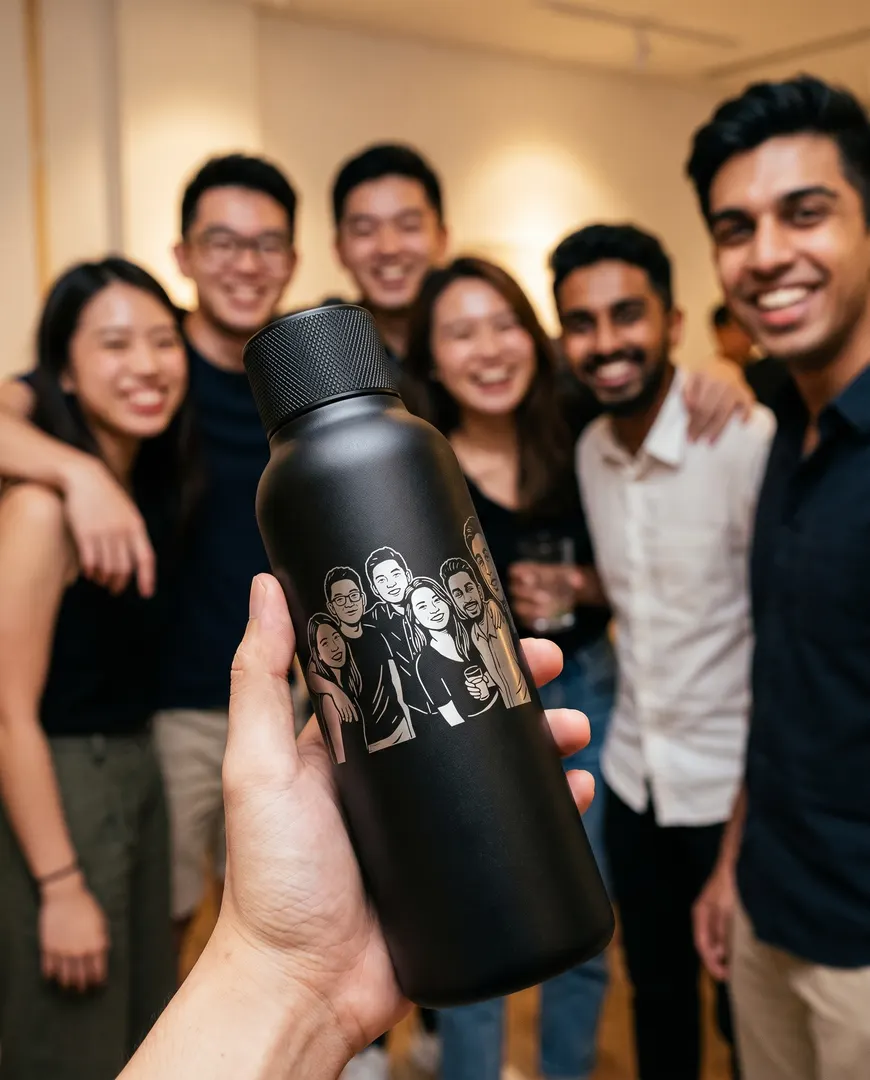
This is the one we run, so here’s exactly how it works. Guests scan a QR code with their own phone. There’s no app and no sign-up. They take a photo or pick one from their camera roll, and about 20 seconds later they see it as clean line art on the item they’ll take home. They add a short line of text, send it, and get a ticket number. When it’s ready they get a WhatsApp and their number shows on the booth screen, so nobody stands in line while it’s engraved on site.
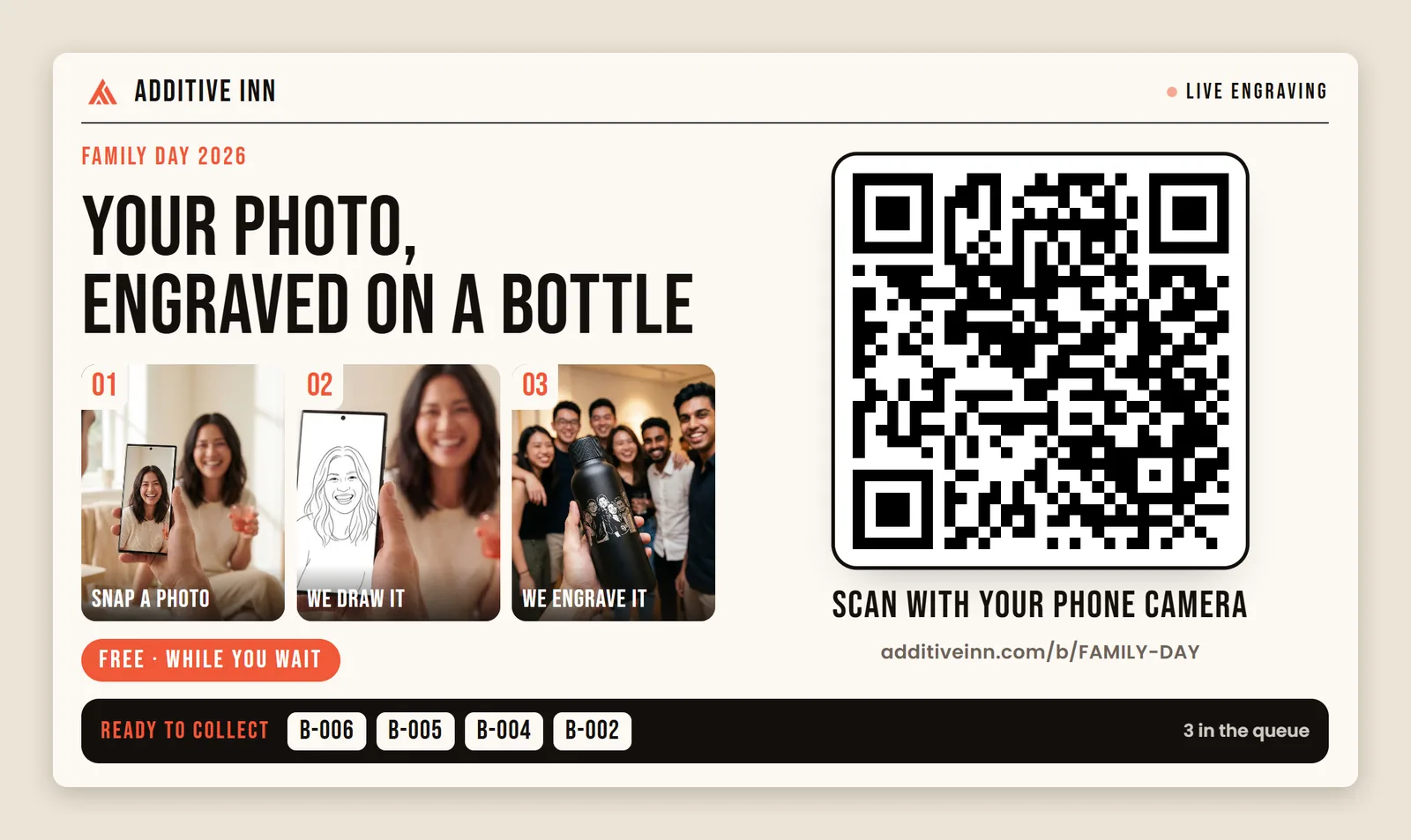
- What guests engrave: portraits, groups, pets and company logos.
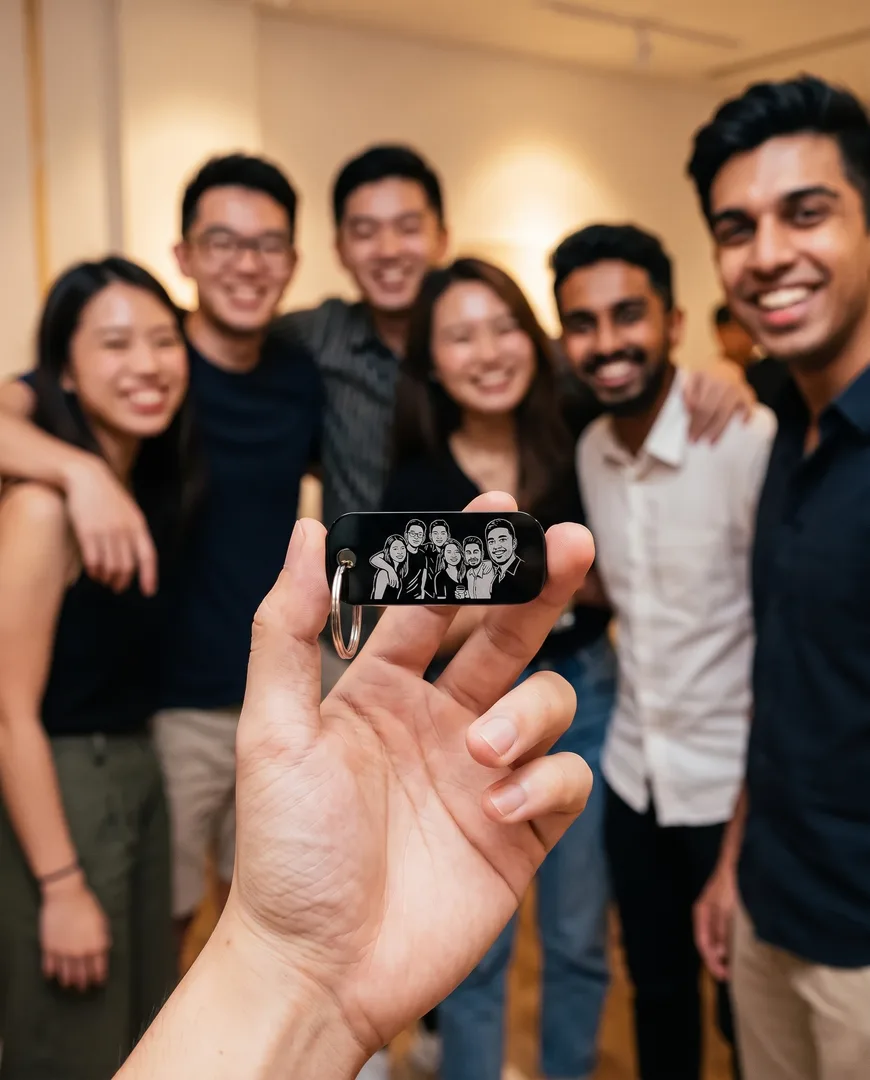
- What it goes on: stainless steel bottles, black acrylic keychains (55 x 20 mm, with the text set beside the portrait) and mirror steel luggage tags on a leather strap.
- Your brand: your logo sits on the page guests open and on the booth screen.
- A person checks every drawing before it’s engraved.
- No venue wifi needed. The guest page runs on each guest’s own mobile data.
- What we need: a table about 1.8 m long and one power point.
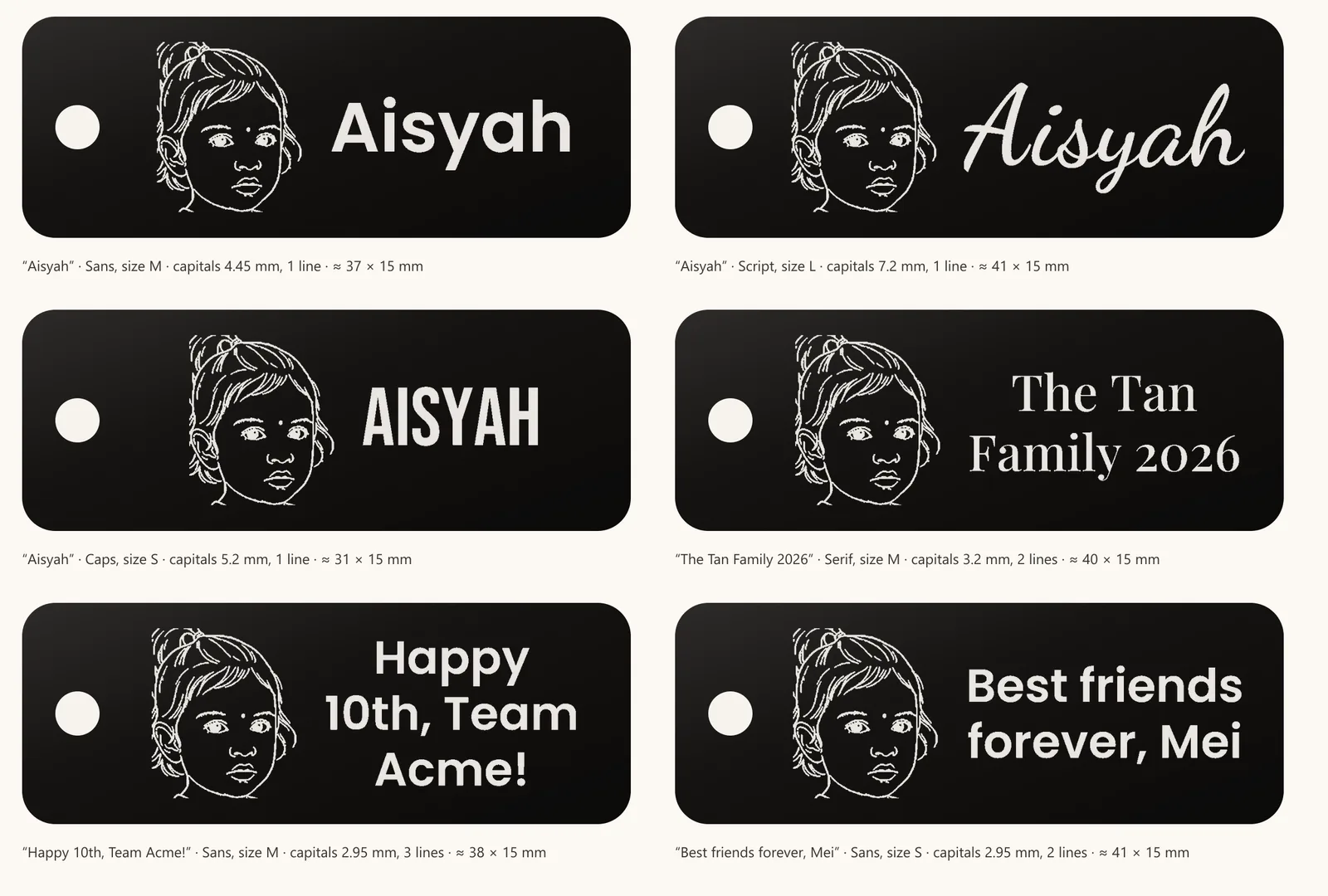
The honest limits:
- One person runs the laser at each station, and every piece takes its own time. A big crowd arriving at once needs a plan, so tell us your headcount early and we’ll set the item and the hours around it.
- The laser and the screen need shade and cover. At an outdoor family day, put the booth under a tent, away from rain and direct sun.
- Line art keeps the shapes of a face, not every fine detail. A clear, well-lit photo comes out best.
- Guests type their own text, so a misspelt name gets engraved as typed. Our team checks each drawing, but the guest’s spelling is theirs.
Carnival games
Carnival games are the classic family day fringe: tin can toss, ring toss, hook-a-duck, basketball shoots. They’re quick, cheap to run per play and work for every age. Most need no power at all.
- Best for: family days and anything outdoors.
- Prizes are a cost of their own. Budget for them separately, and pick prizes that won’t end up in the bin by the car park.
- Someone has to run each stall. Check whether the vendor sends staff or expects your volunteers to man them.
- They need space. A row of game stalls takes far more floor than a single booth.
Kids’ stations: face painting and crafts
Kids’ stations keep children busy so the adults can talk. Face painting is the favourite, and craft tables (sand art, colouring, slime, bead bracelets) let kids make something to take home.
- Best for: family days, and any event where staff bring children.
- Face painting is slow. A full face takes several minutes, so a long queue of kids forms quickly. Simpler cheek designs move faster.
- Check what goes on skin. Ask for cosmetic-grade paints and a quick allergy question before the brush touches a face.
- Crafts need supervision and a table where glue and glitter can live.
Roving entertainers
Roving entertainers come to the guests instead of the other way around. Caricature artists, close-up magicians, balloon sculptors and stilt walkers all fit here.
- Best for: D&Ds and seated dinners, where guests won’t leave the table, and as a filler at any event.
- Caricatures are a take-home but one face takes a few minutes. Two artists for a big room is common.
- Balloons don’t last. Kids love them, but they’re gone by the next morning.
- No space or power needed, which makes them the easiest thing to add to a venue that’s already full.
Food carts
Popcorn, candy floss, ice cream, kacang puteh, bubble tea: a food cart is a fringe activity that doubles as catering. It’s fast, it draws a crowd and almost everyone joins in.
- Best for: family days and long afternoon events.
- Dietary needs matter. For a mixed Singapore crowd, ask whether the vendor is halal-certified and check the certificate covers the outlet that’s serving.
- Most carts need power, and some need a water point. Ask before you pick the spot.
- Heat is the enemy of ice cream and chocolate outdoors, so keep those carts in the shade.
Frequently asked
How many fringe activities do I need for 300 guests?
Usually three to five stations. Assume about half your guests try any one activity during the open window, then divide by the hours. For 300 guests over three hours that's around 50 people an hour per popular station, so a slow, one-at-a-time activity needs a second artist or a booking slot.
How much space and power does a fringe activity need?
Plan on a table about 1.8 m long plus room for a short queue in front, which is roughly a 3 m by 3 m patch per station. Anything with a printer, a laser, a screen or a heat press needs its own power point. Ask the venue how many sockets are free near your spot, because running cables across a walkway is usually not allowed.
How far ahead should I book fringe activities in Singapore?
Aim for six to eight weeks. The year-end D&D season and the weeks before Chinese New Year book out first, so for a December or January event start earlier. Kids' entertainers fill up fast around school holidays too.
Do take-home activities need a queue plan?
Yes. Anything that makes something per guest has a fixed time per piece, so the queue grows if everyone arrives at once. Ticket numbers help most: guests leave the line, carry on with the event and come back when they're called. Opening the station early, before the dinner or the main programme, also spreads the crowd.
What works for a family day with both adults and kids?
Mix one activity kids can do alone, like face painting or a craft table, with one families do together, like a photo booth or a game with prizes. A take-home with the family's own photo or name on it suits both ages, as long as the station can keep pace with the headcount.
Who pays for the items guests take home?
Either works. Most companies cover the take-homes for a staff event, so nobody has to pay at the station. At a public or mixed event, guests can pay per piece instead. Decide before you book, because it changes how the station is run and how many pieces to bring.
Related
-
 GuideDoor gift ideas for Singapore events, by what people actually keep
 -
 GuideUnique corporate gift ideas worth keeping
 -
 GuidePersonalised corporate gifts in Singapore: which technique fits your list?
 -
 ServiceLive Engraving Booth
 -
 ServiceCustomised Corporate Gifts
 -
 ServiceLaser Engraving & Cutting
 -
 ProjectPersonalised Tumbler Engraving
 -
 ProjectSamsung Galaxy S26 Privacy Display Booth
 -
 ProjectGoldlion Interactive Shirt Display