

Bambu Lab Air Filter
$12.00 – $36.00 SGD
excl. GST · 9% added at checkout
Made to order
Activated carbon, for the X1 Carbon, X1E and P1S. Traps the VOCs an enclosed chamber holds in when printing ABS, PC or nylon. P1P has no enclosure and doesn't take one.
Made to order, ships in about 7 days.
SKU · BL-AIRFILTER-X1P1
Bambu Lab
Bambu Lab Air Filter
A true consumable: it traps the fumes an enclosed chamber holds in, and unlike a nozzle or a plate, there's no visible sign it's failing until the smell tells you.
Which filter fits your printer
One filter per printer series. Pick yours first.
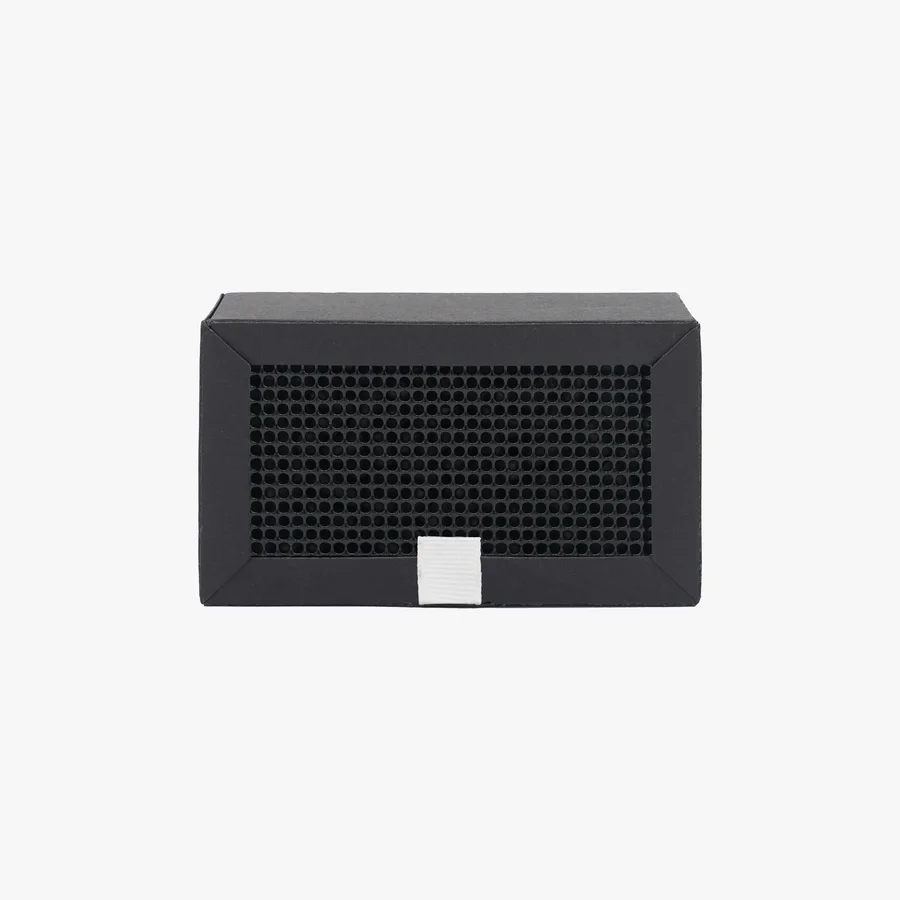
X1 / P1SS$12
For the X1 Carbon, X1E and P1S. P1P ships without an enclosed chamber, so it has nothing for a filter like this to do.
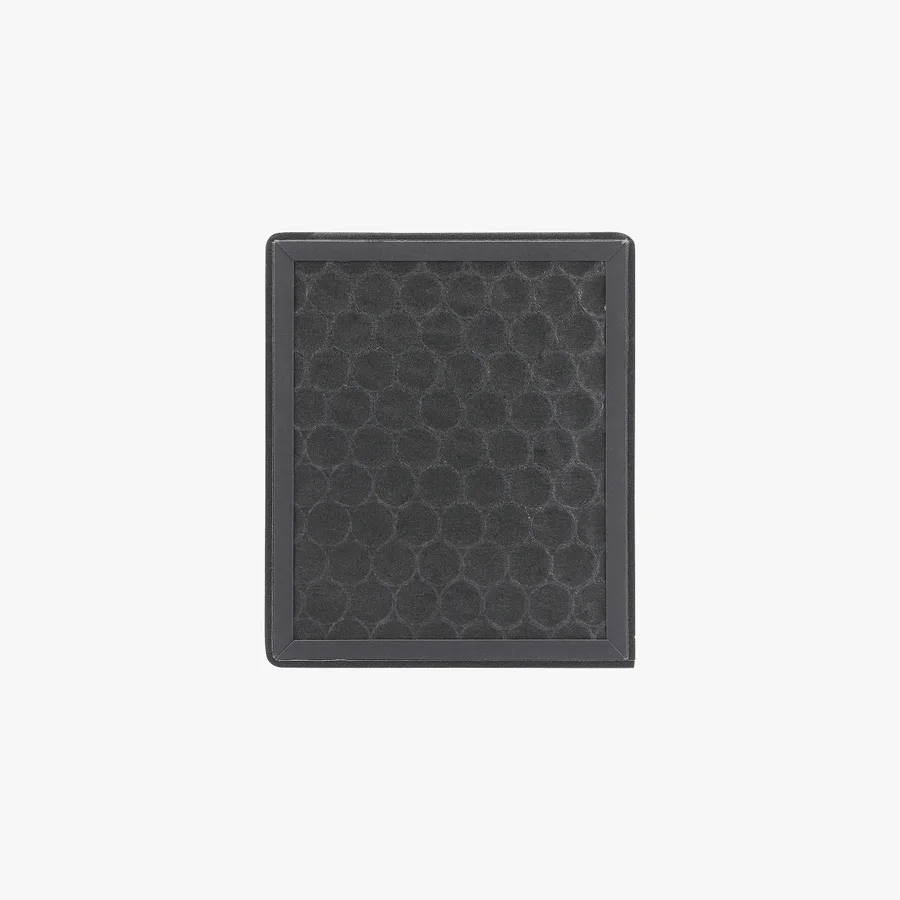
H2 SeriesS$36
One filter covers the H2S, H2D and H2C.
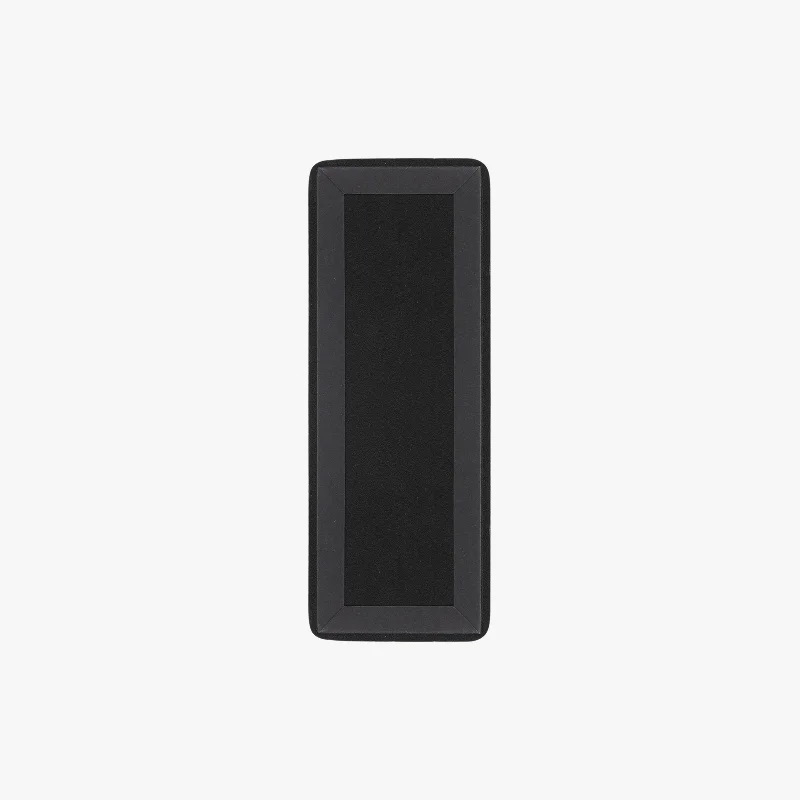
P2SS$26
The P2S's own chamber air filter.
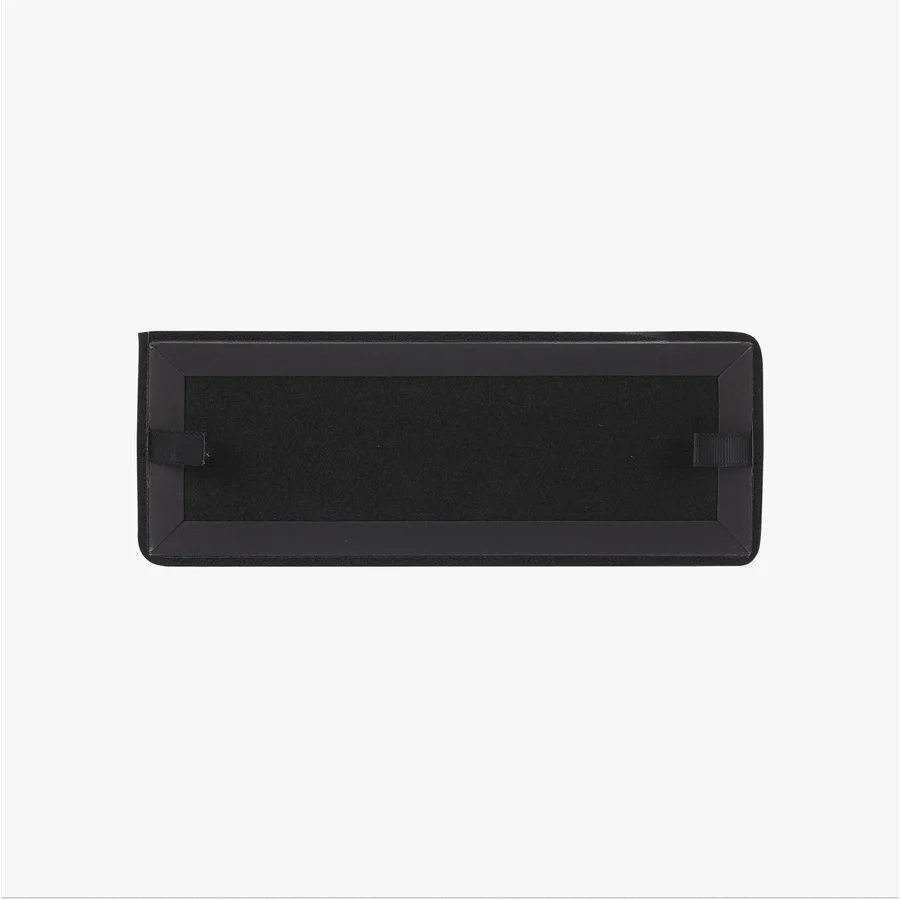
X2DS$30
The X2D's own chamber air filter.
A closed box has to vent somewhere
The enclosure that holds heat in holds everything else in with it.
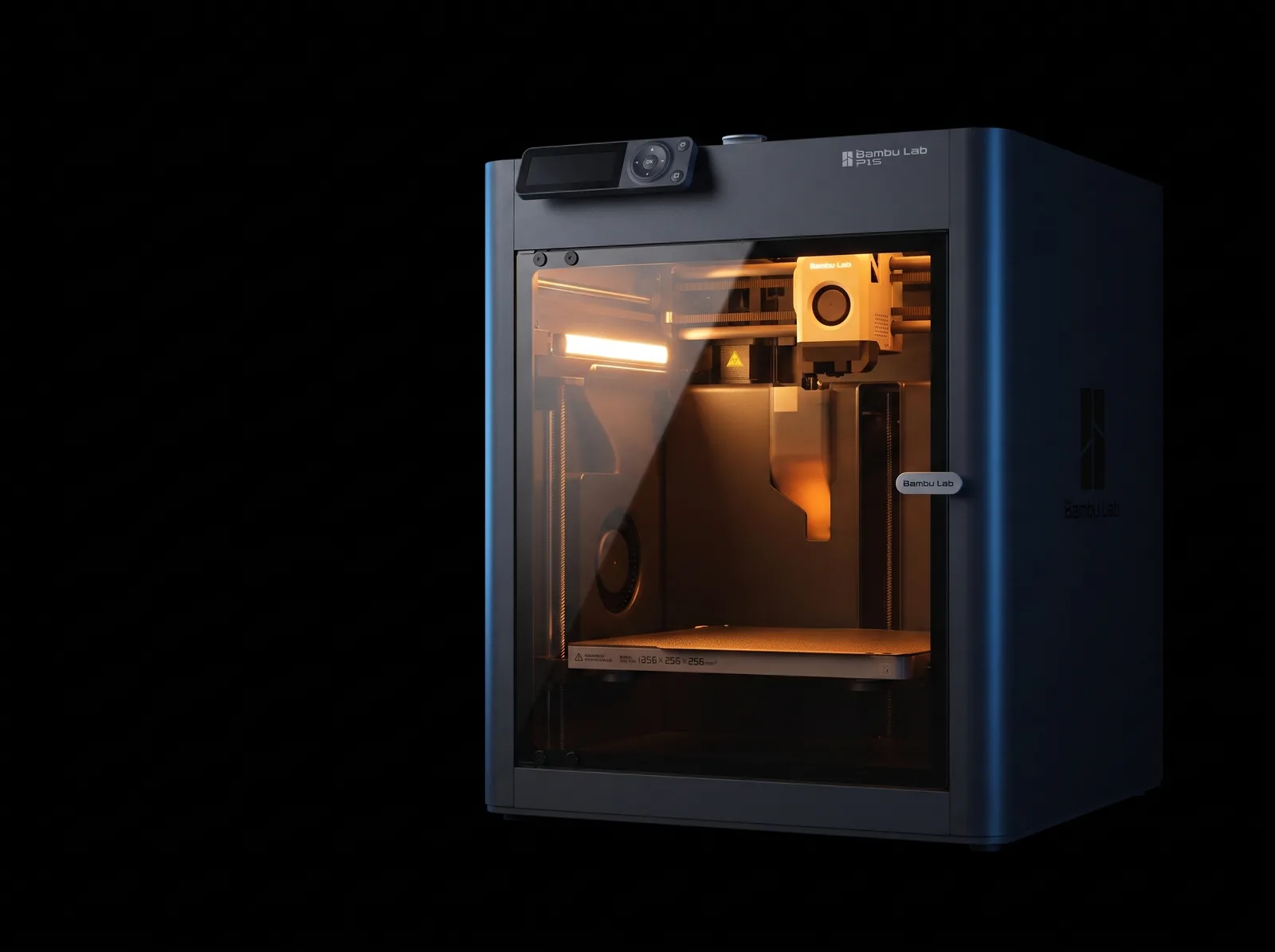
An enclosure is what makes ABS, ASA, PC and nylon printable: it keeps the chamber warm and still so a tall part doesn't warp or split. It also means several hours of hot plastic vapour with one way out.
That way out is the chamber fan, and the filter sits in front of it. On an open-frame machine the same vapour just goes into the room as it's made. That's why a P1P has no filter to buy and a P1S does.
What it actually traps
A chamber filter, not a room air purifier.
Melt extrusion printing gives off VOCs, and how much comes down to the material. ABS, PC and nylon print hotter, so they give off more. PLA prints much cooler and gives off far less.
The filter itself is activated carbon. Air from the chamber passes through it before venting, and the carbon absorbs the VOCs instead of letting them straight into the room.
It cleans the air the printer itself is venting. That matters most on an enclosed machine running a high-temperature material for hours at a time. It won't do anything about the rest of the room.
Three parts, one of them cleans air
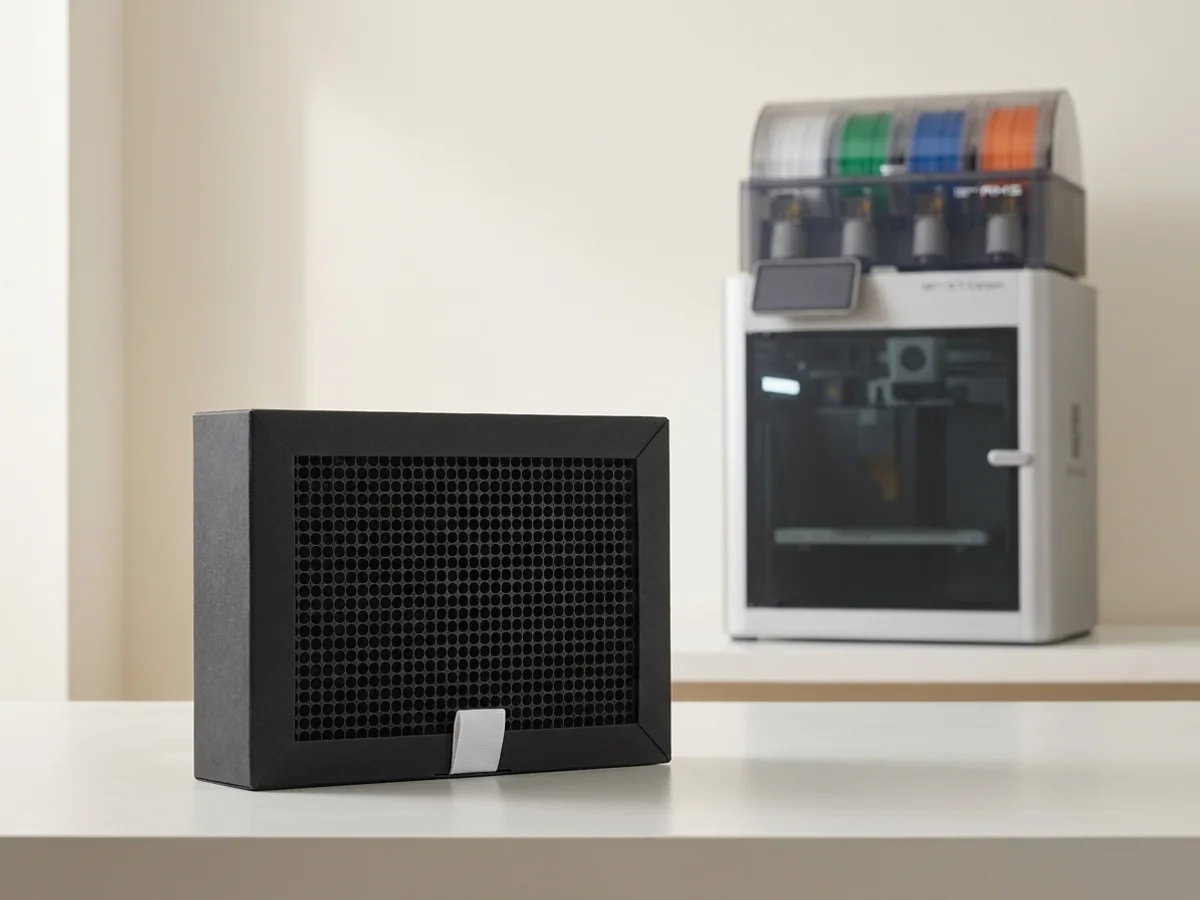
The chamber's air path has three pieces and only the first is a filter. Knowing which is which saves buying the wrong spare, or expecting the wrong thing from the right one.
The air filterThis page
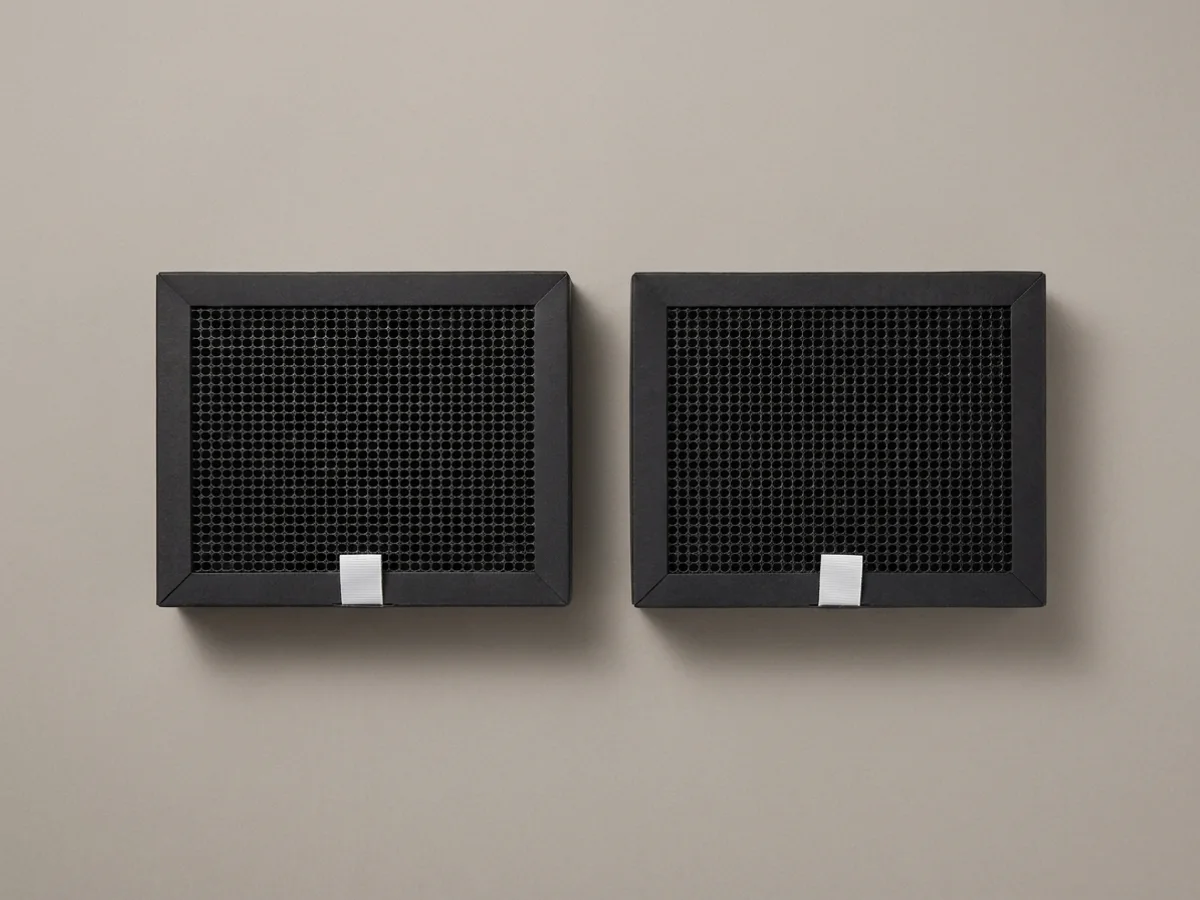
The activated carbon element that sits inside the right liner, the side closest to the chamber. It's what adsorbs VOCs, and it's the one of the three that runs out on an hour count.
The air filter cover
A separate clip-on shell you take off first. It carries its own mesh on the inside, and that mesh is there to stop chamber debris reaching the chamber exhaust fan. It's a debris guard, not an air-cleaning stage. No hour rating: clean it every 3 months, replace it if it's cracked or warped.
Actual ventilation
Ducting that takes fumes out of the room instead of round it. Bambu sells a different part for it on every machine, and none of them is this filter. The ABS and ASA panel below names the one your printer takes.
Knowing when to swap it
There's no window, no indicator and no dye. Bambu's hour count is the clock, and your nose is the check on it.
Bambu rates all four of these at 1440 hours of cumulative printing time, about 60 days. Read that as hours the printer actually ran, not months on the shelf. A machine doing a couple of hours a week takes years to get there; a shop running it flat out gets there in two months.
Activated carbon doesn't regenerate. Once it's saturated it stops adsorbing and starts letting VOCs pass straight through, and nothing on the printer announces the moment that happens. The hour count is the only real gauge, and your nose is the backup.
The people who need to watch it closest are anyone printing ABS, ASA, PC or nylon regularly. If a smell that used to be faint gets stronger, or turns up on a material it never used to, that's the carbon telling you it's done.
PLA-only users can leave it far longer. It's cheap enough, though, that swapping it on suspicion rather than waiting for certainty is a reasonable call either way.
ABS and ASA still want a ventilated room
A carbon filter cleans the chamber's air. It doesn't ventilate the room, and it was never meant to.
Print PLA or PETG and the filter is doing everything you need. ABS, ASA, PC and nylon are a different question. They run hot, they smell, and by Bambu's own account they give off far more VOCs. Open a window, run a fan, or put the machine somewhere you're not sitting for eight hours.
There's a wrinkle on the H2 series worth knowing before you rely on it. When you print ABS, ASA or PA, the chamber exhaust and the external exhaust fan stay shut for the whole print, because opening them would drop the chamber temperature and warp the part. The printer runs them for two minutes after the job to clear the chamber. So during a hot print, by design, nothing is being extracted.
Bambu's own answer for these materials isn't a better carbon element, it's external exhaust: the External Exhaust Fan Kit on the P2S, a 100 mm ventilation pipe on the X2D, or the Smoke Purifier on the H2. Tell us your model and we'll tell you which one it takes.
This matters more in Singapore than the marketing copy assumes. Most workshops here run the air-con with everything shut, which is the worst case for a sealed room and a hot print. If you can't duct it, at least put the printer where the air moves and don't share a bedroom with an overnight ABS job.
The laser combo's fumes are a separate system
Two jobs, two systems, and one of them isn't this part.
An H2 series printer sold with the laser module doesn't vent cutting fumes through this chamber filter. It has its own smoke extraction system, a ventilation pipe and adapter.
The extraction machine is the Bambu Smoke Purifier, and it's a real four-stage stack rather than a carbon box: a G4 cotton pre-filter for dust and larger particles, an F8 medium-efficiency particulate filter, a carbon filter rated at 1200 mg/g for VOCs, then a HEPA H13 for ultra-fine particles down to 0.3 µm. Bambu's headline for the whole stack is 99% of particles down to 0.3 µm. That's the only place in the range a HEPA number appears.
It doesn't switch itself on. There's no link to the printer, so you turn it on and set the fan speed by hand, and it beeps when a filter reaches end of life. It also works on a non-laser H2, which is worth knowing if you print a lot of ABS.
The two jobs don't overlap. This filter cleans the print chamber's own air; the laser's ventilation carries cutting smoke out of the room entirely. And the 1440 hour figure on this page doesn't cover laser use, because Bambu is still testing that interval. Ask us about the extraction side separately if you're running the laser module.
Before you order
These are genuine Bambu Lab filters, matched one to one with a printer series. Tell us your model if you're not sure which applies, especially between P1P (no filter) and P1S (takes one).
Prices exclude GST. We add 9% at checkout. PayNow is free; paying by card adds a flat 4% processing fee. Self-collect free at Bendemeer, or islandwide courier at $15 flat, free once the order passes $250 before GST.
Which models each filter covers
| Filter | Fits | Price |
|---|---|---|
| X1 / P1S | X1 Carbon, X1E, P1S | S$12 |
| H2 Series | H2S, H2D, H2C | S$36 |
| P2S | P2S | S$26 |
| X2D | X2D | S$30 |
Swipe the table sideways for every column
P1P is left out deliberately: it ships without an enclosed chamber, so there's nothing for a chamber filter to do.
The four filters, spec by spec
Bambu's own published figures. Your printer's column is highlighted.
| Spec | X1 / P1S | H2 Series | P2S | X2D |
|---|---|---|---|---|
| Fits | X1 Carbon, X1E, P1S | H2S, H2D, H2C | P2S | X2D |
| Media, as published | Paper box, activated carbon | Activated carbon element in a plastic frame | Activated carbon element; plastic, aluminium and copper | Plastic, activated carbon |
| Stages in this part | One. Bambu's own name for it is the activated carbon air filter | One. The maintenance guide calls it the activated carbon filter throughout | One. Bambu calls it a replaceable activated-carbon filter | One. Bambu calls it a replaceable activated-carbon filter |
| What the machine's own spec lists | Activated carbon filter | Pre-filter grade G3, HEPA grade H12, activated carbon type granulated coconut shell | Activated carbon, VOC and particulate filtration | Pre-filter grade G3, HEPA grade H12, activated carbon type granulated coconut shell |
| Where it sits | In the exhaust path out of the enclosure, behind the plastic door on the right | Inside the right inner liner, the face closest to the chamber | Inside the right chamber liner | Inside the right chamber liner |
| Packed size | 109 × 55 × 33 mm | 155 × 78 × 268 mm | 195 × 130 × 45 mm | 225 × 75 × 45 mm |
| Packed weight | 110 g | 245 g | 158 g | 82.5 g |
| In the box | Filter × 1 | Air filter × 1 | Air filter element × 1 | Air filter × 1 |
| Colour | Black | Black | Black | Black |
| Tools to change it | None | None. Gloves if the old one is dirty | None. Tweezers help if the cover is tight | None. Tweezers help if the cover is tight |
Swipe the table sideways for every column
The machine's purification system and the part you buy are not the same object. On an H2 or an X2D the printer's spec sheet lists a G3 pre-filter and an H12 HEPA grade alongside the carbon, but Bambu sells one replaceable element per machine and never says which of those stages sit inside it. So we won't tell you this cartridge is a HEPA. What all four of them are described as, in Bambu's own writing, is activated carbon.
What it traps, and what it isn't rated for
The second half of this list is the honest one. Everything in it is an absence in Bambu's own documentation, not our opinion.
| Traps | VOCs. Bambu's wording: melt extrusion printers give off VOCs, and ABS, PC and PA run hot enough to give off more of them. PLA melts cooler and gives off far fewer. The carbon adsorbs them instead of letting them straight into the room. |
|---|---|
| Not HEPA | None of the four is described as HEPA anywhere in Bambu's documentation. It's a carbon stage. The only Bambu product carrying a HEPA claim is the Smoke Purifier, a separate machine with its own H13 element. |
| No particle rating | No micron figure, no capture percentage, no particle count is published for any of the four printer filters. The 99% capture claim you may have read is the Smoke Purifier's, a separate machine. |
| Ultrafine particles | Unrated. Enclosed printing does produce them, and Bambu publishes no figure for how many of them the carbon element catches. |
| Styrene | Bambu never names it. ABS gives off styrene when it melts, that's chemistry rather than a spec, but no capture figure exists for these filters. Treat styrene as a reason to ventilate, not as something this part is rated against. |
| Saturation warning | There isn't one. No dye, no window, no counter, no alert. Carbon adsorbs until it's full and then passes the rest through, silently. |
| Regeneration | None published. You can't bake it and put it back. When it's spent it's spent. |
| Room air | It cleans air the printer is already moving through its own chamber. It does nothing for the rest of the room, and nothing about what escaped when you opened the door. |
| P1P | Nothing to fit. The P1P is the open-frame machine, so there's no enclosed chamber and no filter slot. The compatibility field on Bambu's own listing reads "X1 Series and P1S". |
Replacement intervals
Three different parts, three different clocks, and one that Bambu hasn't published yet.
| Air filter, printing only | 1440 hours of cumulative printing time, about 60 days. Bambu's figure, identical across all four filters. |
|---|---|
| Air filter, laser engraving or cutting | Not published. Bambu says the interval for laser use is still being tested. Don't apply the 1440 hour number to laser work. |
| Air filter cover | No hour figure. Replace it if it's damaged or deformed, and clean it every 3 months so its debris mesh keeps the chamber exhaust fan clear. |
| If you print engineering materials | Halve the cleaning cadence. The H2 maintenance schedule's own rule is that three-month jobs become monthly and monthly jobs become fortnightly when you're running high-temperature or engineering filament. |
Hours of printing, not hours since purchase. The printer counts them for you, so check the total print time on the machine rather than the date on the receipt.
The laser extraction system, in numbers
Separate machine, separate consumables, separate ducting. Here's the whole shape of it before you commit a corner of the workshop to it.
| Filtration | Four stages in series: G4 filter cotton (dust and larger particles), F8 medium-efficiency particulate filter, activated carbon rated 1200 mg/g for VOCs, HEPA H13 for the ultra-fine end. |
|---|---|
| Claimed capture | 99% of particles down to 0.3 µm, plus VOCs. This is the one Bambu product that publishes a capture figure. |
| In the box | Purifier, 2 m smoke ventilation pipe, pipe clamp, 3 × primary filter (one already fitted), 1 × medium-efficiency filter (fitted), 1 × HEPA filter (fitted). |
| Not in the box | The pipe and connector between printer and purifier. The 2 m length included is the purifier-to-outdoors run only. A non-laser H2 also needs the ventilation pipe adapter. |
| Filter life | Primary every 80–100 hours, or when more than 70% of its surface is covered in dust. Medium-efficiency every 300–500 hours. HEPA every 800–1000 hours, or when it stops killing the smell. There's no HEPA-only spare: Bambu sells the three as a combo pack. |
| Ducting | Pipe 102 mm, purifier interface 100 mm, ventilation pipe adapter 90–100 mm. Keep each run between 2 and 5 m. Longer runs cut extraction and can damage the motor. |
| Control | Manual. It has no automatic start linked to the printer and the fan speed is a knob, not a slicer setting. It beeps when a filter is spent. |
| Size and weight | Packed 465 × 400 × 620 mm, 17.5 kg. Plan the floor space before you plan the duct. |
| Laser air pump filter | A different consumable again, adhesive-backed under the printer. Inspect every 500 hours. Replace it when the surface looks yellow and clogged, or when cut edges start yellowing, which means pump flow has dropped. Sold in threes. |
We don't stock the purifier on this page. Message us with your model and we'll quote the purifier, the adapter and the length of pipe your room actually needs.
Changing the element
Ten minutes, no tools, and the only step people skip is the first one.
Power off and unplug
Bambu prints this warning on every maintenance page and it's not boilerplate: working inside a live machine risks a short across exposed connectors. Switch it off at the wall and pull the cord.
Get the bed out of the way
On the H2 series, P2S and X2D, use the screen to lower the heatbed to the bottom of the chamber before you power down, so it isn't sitting in front of the filter compartment. On the X1 and P1S the filter is reached from outside, so there's nothing to move.
Take the cover off
X1 and P1S: slide the door left with the knob and pull the plastic tab. H2 series: hold the top of the cover, pull it outward to release the top buckle, then tilt it and lift it away. P2S and X2D: push the left side of the cover to the right to disengage the clip. If it's tight, grip it with tweezers rather than forcing a fingernail behind it.
Pull the old element out
H2 series: it comes out by the drawstring. P2S and X2D: pull the tab at the top or the bottom. X1 and P1S: grip it gently and wiggle it up, down and sideways until it releases. Wear gloves if it's been in a long time on ABS.
Clean the cover while it's in your hand
The mesh on the inside of the cover is what keeps chamber debris out of the exhaust fan, and it's on a 3-month cleaning cycle of its own. Brush the dust off both sides, then wipe it with a non-woven cloth sprayed with alcohol. If it's really caked, Bambu allows rinsing it under the tap with a brush, but dry it completely first: there are electronics around the cover and residual moisture will find them. Wipe out the filter slot in the liner too. If the cover is cracked or deformed, order one, it's a separate part.
Seat the new one
Push it fully home so it sits flush. On the H2 series the drawstring side faces you and points up. On the P2S and X2D it should be flush with the compartment before the cover goes anywhere near it.
Clip the cover back and check it
H2 series: insert the cover diagonally, drop the 5 bottom latches into the liner, then push the top in until the 5 top clips snap. Everywhere else: hinge it back and press until it latches. It should sit flush all the way round with no rocking. If it doesn't, the element isn't fully in.